| |
|
Vibration Isolation from MinusK®
Standard and Custom Vibration Isolation with Better Performance than Active Systems for Air Table Prices
Minus K is an OEM supplier to leading manufacturers of SPMs, microhardness testers, NSOMs and profilers.
Top researchers at over 200
leading universities and government labs have selected
Minus K products to achieve the vibration free platform needed
to achieve the precision needed in their projects!
Advantages of Minus K Products:
- Isolation performance is typically 10 to 100 times better than high-performance air systems
- No air or electric power is required
- Easy to use
- Nothing to wear out
- No maintenance
|
 |
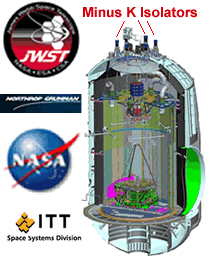
NASA/JPL needed a dynamic test bed for the Space Interferometry Mission (SIM) to demonstrate spacecraft vibration-induced errors of a few nanometers.

Download case study  |
|
|

Mechanical Isolators Stop the Shakes - As Seen in Design News Little-known mechanical alternative to air tables and active vibration isolators tackles low-frequency vibrations
Buildings really do shake and sway under our feet. Most
of us don’t even notice these low-frequency vibrations,
but they can bother the researchers who use sophisticated
imaging systems or test instrument. Whether the cause is
the wind or a nearby HVAC system, low-frequency vibrations
can wreak havoc with the data from scanning probe microscopes,
interferometers, micro-hardness testers and other types
of sensitive test and measurement equipment. This vibration
problem mostly affects researchers who work at atomic and
nanoscale resolutions, but the problem is getting worse... Click
Here For More.
Controlling Vibration in Nanotech Applications - As Seen in Labratory EquipmentNegative-Stiffness Vibration Isolation Offers an Economical Solution
It wasn't too long ago that making the decision where to
locate your scanning probe microscope was a simple one—put
it in the basement where ambient vibration was least. But
recently, with nanotechnology applications growing exponentially,
scientists and engineers are putting their equipment in
locations where vibration noise is significantly high. Scanning
probe microscopes, interferometers and stylus profilers
are being sited in locations that pose a serious challenge
to vibration isolation. Additionally, in an effort to keep
their nano-equipment costs as low as possible by cutting
out the peripherals, many academics and industries are not
adequately providing for vibration isolation on their ultra-sensitive
nano-equipment. Click
Here For More
'Negative stiffness' isolates vibrations - As Seen in EE Times
Minus K Technology Inc. claims that the "negative stiffness"
mechanism it has developed isolates from vibrations better
than traditional solutions. Such techniques provide the
stable platform and angstrom-level accuracy needed to test
microelectro-mechanical systems, nanoscale metrology and
semiconductor fabrication tools, for example. "Our
negative stiffness mechanism exerts an opposing force that
cancels out the stiffness in a spring," said David
Platus, president and CEO of Minus K (Inglewood, Calif.).
"That gives us isolation that is twice as good as other
active systems but for half the price of air table-style
passive vibration isolation systems." Click
Here For More
Better atomic force microscopy for nanoelectronics - As Seen in Laboratory Talk
Arizona State University nanostructures group uses negative-stiffness
vibration isolation to eliminate ultra-low frequencies and
improve data in nanoelectronics AFM research, reports Jim
McMahon. It was not until long after 1977 that the name
nanoelectronics came into use, but David Ferry was already
actively engaged in developing some of the world's smallest
transistors. The field, called ultra-small devices at that
time in the later part of the1970s, was in its infancy,
and Dr Ferry's research team was one of only four select
groups around the world aggressively researching the limits
of small electronic devices. Today, Ferry heads up the nanostructures
research group at Arizona State University (ASU) in Tempe,
a collection of faculty, staff and students working on research
in the regimes of nanolithography, and the physics of nanostructures
and ultra-small semiconductor devices. Click
Here For More
|
|
| |
| |