Analytical Balance Vibration Isolation
Tables, Platforms, Benchtops & Custom Systems for
Analytical Balances
Minus K vibration isolation systems can enable analytical balances
to operate in vibration environments not previously possible,
such as in manufacturing facilities with heavy equipment and
on upper floors of buildings.
Analytical balances are particularly sensitive to vibrations because they introduce g-loads that interfere with the basic weight measurement mechanism - the effect of gravity on a mass. Vibrations reduce the resolutions and prevent the balances from achieving their performance capabilities. High-resolution balances with resolutions down to 1 or 0.1 microgram are particularly sensitive to vibrations, even with the built-in electronic averaging techniques used to compensate for vibrations. A reduction of even one decimal place can seriously affect the usefulness of balances for some applications.
Low-frequency vibrations are particularly difficult to attenuate, such as floor and ground vibrations caused by vehicles or heavy equipment in manufacturing plants. Low-frequency vibrations are also present in upper floors of buildings, particularly horizontal vibrations caused by wind sway and vertical vibrations from footfall or nearby equipment. Consequently, some metrology labs have not been located in manufacturing facilities where they would be most useful, and some laboratories on upper floors of buildings have not been able to use high-resolution balances to their maximum effectiveness.
Traditionally, vibration problems have been solved with “balance
tables” made from marble or other heavy material. These
balance tables reduce vibrations by adding mass and rigidity,
but they have limited effectiveness in high vibration environments.
Air tables have been used with limited success because they
are not effective against low-frequency vibrations and have
limited attenuation of typical ground and building vibrations.
Active or electronic force-cancellation systems have also
been used but these are very expensive and also have limited
dynamic range and cannot handle large amplitude vibrations.
Minus K vibration isolation platforms perform 10-100 times
better than air tables, depending on the vibration frequency,
and even better than active systems for a fraction of the
cost. They have an added advantage over balance tables by providing effective vibration isolation in a compact bench top platform.
We have had some experience with balances where they would not stabilize in the presence of air motion. Our isolators work by providing very low stiffness and can have resonant frequenc as low as 0.5 Hz. It takes very little force to get them moving so, shielding the isolator and balance from air currents is sometimes necessary. Added mass also helps.
If you are in the U.S. and have an analytical balance issue, please Contact us regarding trial use of our isolation platforms.
 |
 |
|||||
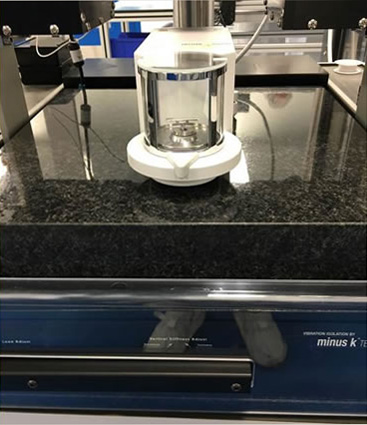
Mettler Toledo XP2U Analytical Balance on a Minus K Customized BM-8 |
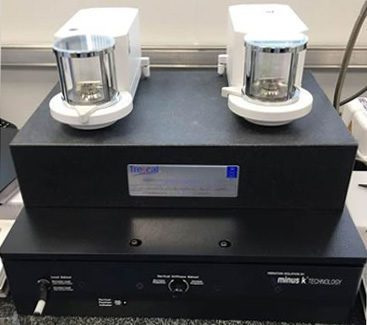
Two Mettler Toledo XP2U Analytical Balances on a Minus K BM-8 |
From Minus K: Analytical balance vibration isolation table, platform
and bench top products,
plus custom
systems.