|
|
Newsletter Sep 2026 | Menu of
Newsletters
|
|
The Nanomaterials Lab at
the University of North Texas – a research group which strives to better
understand the unique properties of nanoscale materials – has been
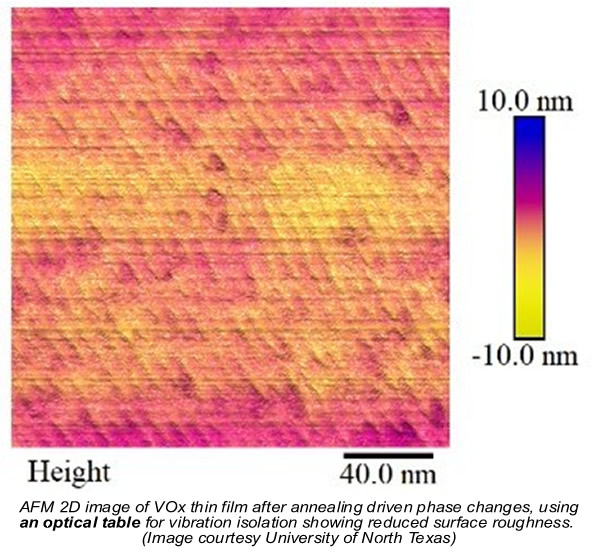
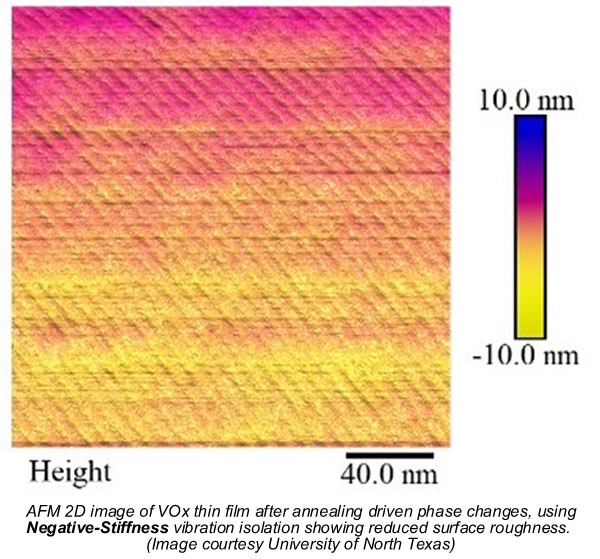
experimenting with annealing driven phase changes in vanadium oxide thin films
and their impact on bolometric characteristics. The lab’s recent research,
assisted by Negative-Stiffness vibration isolation, demonstrate that stress
relaxation, crystallite formation, changes in resistivity and noise, which
influence the film’s electrical properties, are governed by specific
annealing conditions. Vanadium oxide thin films are critical nanomaterials
necessary for uncooled microbolometers used in applications including military,
aerospace, gas analysis, security systems and medical
imaging.
Bolometric sensors are widely used in devices that detect heat
or electromagnetic radiation by measuring temperature-induced changes in
electrical resistance. Bolometers are primarily categorized by their sensing
materials, operating temperatures, and the physical mechanisms they use to
detect thermal energy, with two categories being prevalent in use:
a)
Cooled bolometers which operate at cryogenic temperatures (e.g. liquid helium
~4.2 K or liquid nitrogen ~77 K), to achieve high sensitivity and low noise.
They are essential for astronomical observations and high-end scientific
experiments.
b) Uncooled (room temperature) bolometers usually designed
as microbolometers, operate without cryogenic cooling, and are widely used in
commercial thermal imaging, security, and automotive safety.
This paper
focuses on recent research developments regarding structural and electrical
changes within microbolometers.
Microbolometers
A
microbolometer is a highly sensitive instrument that detects radiant energy by
measuring the change in electrical resistance of a conductor as its temperature
changes. Leveraging MEMS (Micro-Electro-Mechanical Systems) technology for mass
production and uncooled operation, they work by absorbing infrared energy,
which heats a thermistor element, changing its electrical resistance, and
mapping this change into a visible thermal image.
A thermistor element
is a semiconductor device made from metallic oxide thin films, such as vanadium
oxide (VOx), that changes its electrical resistance dramatically with
temperature, allowing it to function as a highly accurate temperature sensor or
controller in electronics.
The important figures of merit for a thermal
sensing membrane are the material's temperature coefficient of resistivity
(TCR), and electrical noise. TCR quantifies how much a material's electrical
resistance changes per degree of temperature change, crucial for electronics
design.
Highly resistive films typically exhibit high TCR values and
high signal-to noise ratios, factors that influence their performance in
bolometer applications.
VOx Thin Films
VOx constitutes a
class of materials characterized by significant physical and chemical
properties. They exhibit intriguing solid-state physics, centered around phase
transitions, in particular metal/insulator transitions as a function of
temperature, which display peculiar structural, electronic, and magnetic
behavior.
VOx thin films are the materials of choice for uncooled
infrared microbolometers used in thermal radiation sensing. Ranging from a
single atom to a few micrometers thick, thin films are used to modify surfaces
for various technology applications, such as solar cells and integrated
circuits, created by depositing material to control electrical or optical
functions, or provide protective properties.
VOx thin films are the
materials of choice for uncooled infrared microbolometers used in thermal
radiation sensing. Ranging from a single atom to a few micrometers thick, thin
films are used to modify surfaces for various technology applications, such as
solar cells and integrated circuits, created by depositing material to control
electrical or optical functions, or provide protective properties...
|
|
|
|
|
|
|
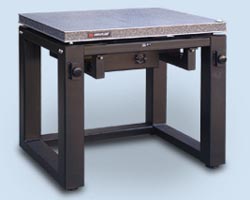
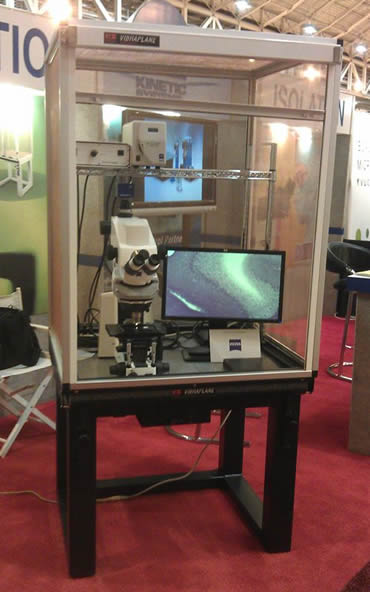
Giving away $25,000* worth of patented vibration
isolators to colleges within the United States.
Your college could
receive one of our superior performing negative-stiffness low-frequency
vibration isolators, which DO NOT USE air, electricity, computers, magnets
or fluids and are currently being used for biology, neuroscience,
chemistry, crystal growing, physics, audio reproduction and many other fields.
If you have an Atomic Force Microscope (AFM), Electron Microscope,
Interferometer, Laser Optical System, Micro Hardness Tester, or any other
special equipment that would be assisted by our vibration isolation, simply
complete the giveaway
submission form
(word.doc) or
submission form
(pdf) and send it back to
edgiveaway@minusk.com.
If you're one of the top applicants, we'll send you one of these free vibration
isolators to assist you with your research.
Submission
deadline for applications is February 28,
2027...
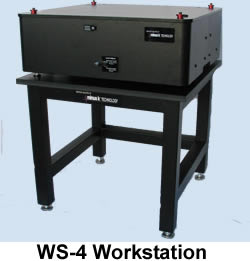
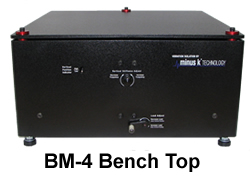
*$25,000 of
retail products will consist of at least one each of the following models of
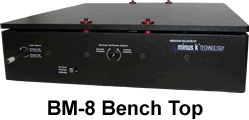
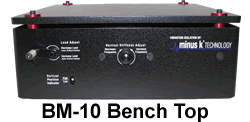
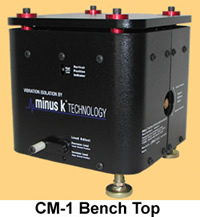
Negative-Stiffness vibration isolators: WS-4, BM-1, BM-4, BM-8, BM-10 and CM-1.
Based on the information provided within grant forms Minus K may substitute
different models to best accommodate the application and payload
needs.
|
|
|
|
University of
North Texas - Physics Department
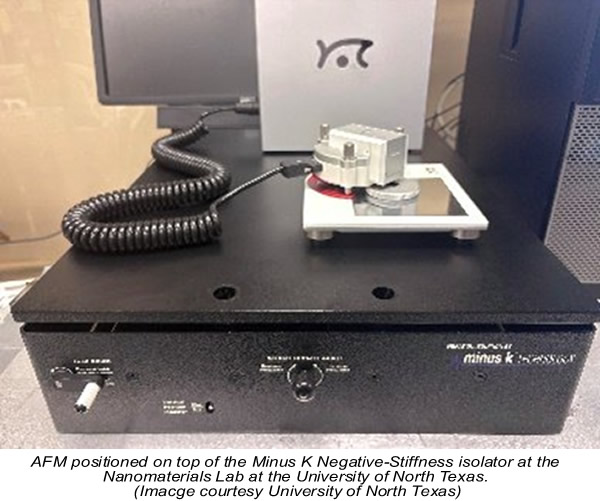
The vibration isolator will be used
to stabilize their AFM to achieve high resolution images of grain sizes in thin
films. They will modify these films through different thermal
processes.
Rose-Hulman
Institute of Technology - Physics and Optical Engineering Department
The vibration isolator will be used for experiments in ultra-sensitive
optical measurements and characterization of magneto-optic nanoparticles for
cancer hyperthermia therapy.
Wellesley College
– Chemistry Department
The isolator will for research studies of
pathological changes to excitable cells using fluorescent reporters. They will
use microinjection and electrophysiology on intact worms in vivo and culture
cells using their Nikon Ti-U microscope which currently has too much vibration
movement.
Cornell University
– Applied and Engineering Physics Department
The isolator will
used fabricating novel two-dimensional (2D) material heterostructures by
combining atomically thin 2D materials, such as graphene, hBN, transition metal
dichalcogenides, to explore new electronic and quantum phenomena inside an
MBraun glovebox under an inert argon atmosphere.
Rutgers University
– Physics Department
The isolator will be for a scalable atomic
gravimeter to measure the absolute gravity, the vertical gravity gradient, and
the third-order vertical derivative by dropping three spatially separated
cold-atom cloud and forming atom interferometry, to a retroreflector under a
vacuum chamber.
Sam Houston State
University – Biological Sciences
The isolator will assist in
fluorescent and phase contrast imaging using an ECHO Revolve upright/inverted
microscope, allowing publication-quality fluorescence, phase, and darkfield
imaging to graduate and undergraduates in research or doing live-cell
video. |
| Check out previous
Educational Giveaway winners: |
|
|
|
|
|
|
Standard
and Custom Vibration Isolation with Better Performance than Active Systems
Cutting Edge Vibration Isolation for use in...
|
|
|
|
|
Previous
Newsletters
|

 |
|
|