|
|
Newsletter March 2026 | Menu of
Newsletters
Helium-Free Magnetic Refrigeration
Supports Continuous
Milli-Kelvin Temperatures for Quantum
Research
|
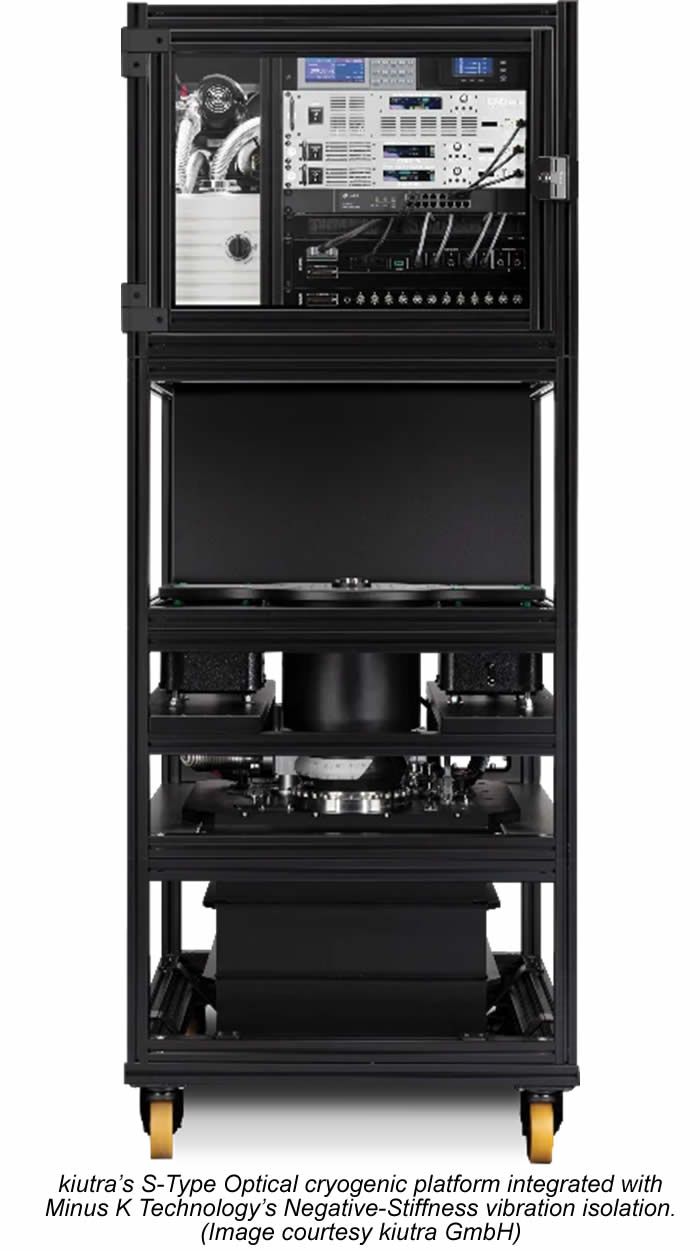
|
Cryogenic
characterization is a must to accelerate and enable breakthrough science and
quantum technologies. Quantum sensors, quantum communication devices and future
quantum computers will rely on scalable and efficient cooling for their
operation.
Quantum computers rely on qubits, which can exist in
multiple states simultaneously. These quantum states are extremely fragile and
susceptible to disruption from environmental noise, especially thermal energy.
Many quantum computing approaches, especially those utilizing superconducting
qubits, rely on superconductivity, which occurs at extremely low
temperatures. Cryogenic temperatures, near absolute zero, minimize thermal
fluctuations, allowing qubits to maintain their coherence for longer, enabling
complex quantum computations.
Magnetic refrigeration is emerging as a
promising technology for achieving these conditions. Traditional cryogenic
cooling using liquid helium is expensive and complex, while magnetic
refrigeration offers a potentially simpler, more scalable, and cost-effective
solution.
Magnetic Refrigeration
Magnetic refrigeration aids
in producing extremely low temperatures at almost absolute zero temperature
(called sub-Kelvin temperatures, below -273°C) by using the relationship
between a magnetic field and entropy in certain materials.
Entropy
refers to the disorder or randomness in a material. In magnetic materials, the
entropy is composed of essentially two parts: a) the entropy of the crystalline
structure, where greater entropy means higher temperature due to vibrations of
the crystal lattice; and b) the entropy of the magnetic moments of the
crystalline material. Magnetic moments are a vector quantity that represents
the magnetic strength and orientation of the magnetic object. A collection of
magnetic moments is called a spin system. The way the entropy of this spin
system responds to a magnetic field is at the very core of magnetic
refrigeration.
Here is the process:
Full
article...
|
|
|
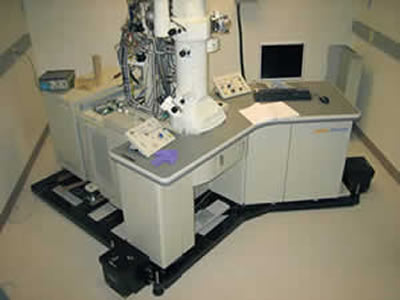
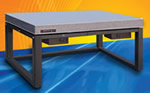
The
FP-1
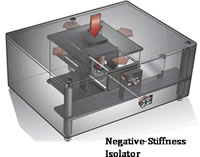
consists of a large platform, atop two to four Minus K®
SM-1
negative-stiffness vibration isolators, with outriggers which connect the
platform to the isolators, isolator floor and jack screw plates which help to
spread the load on the floor and ballast weights. The
FP-1
platform is a heavy steel plate which typically weighs nearly as much as the
microscope itself. One reason for this design is to lower the overall system
center of gravity to the level of the isolator tilt mechanism, so as to avoid
horizontal-tilt coupling, which occurs when horizontal vibrations cause both a
horizontal and tilting response of the column. With the system CG at the level
of the isolator tilt mechanism, the vibrations are decoupled and better
isolation control is achieved. Another reason for the massive platform is that
the large total mass of the system helps to diminish any effects from stiff
cables and hoses connected to the microscope.
|
| |
|
|
|
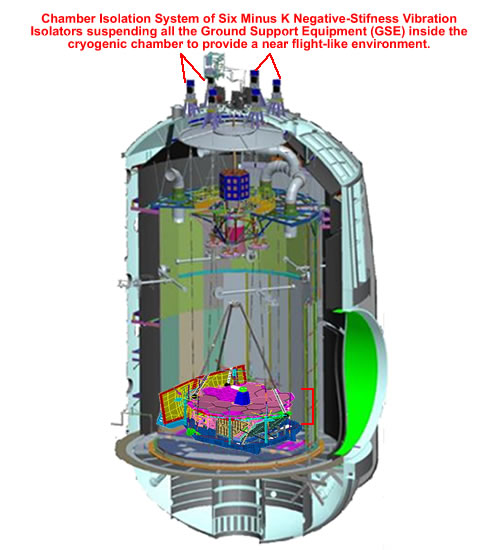
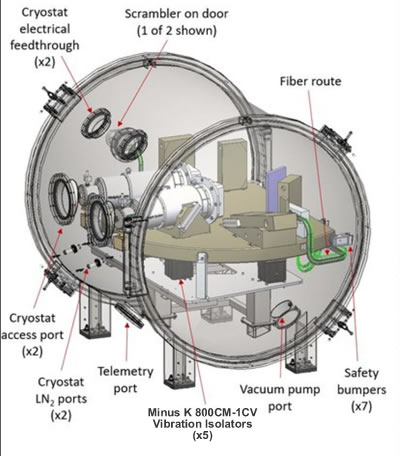
Vacuum
Chamber Vibration Isolation
Minus K vibration
isolation systems can be made vacuum compatible so they can be used right
inside vacuum chambers. In addition to their superior vibration
isolation performance, this offers other advantages of much lower payload
weights, more compact systems, and eliminates problems associated with vacuum
chamber feed-throughs. See below example with NASA/JPL SIM Interferometer
Testbed Spectral Calibration Development Unit (SCDU).
Our vibration
isolation systems have also been used to support entire vacuum chambers.
This offers the advantages of more standard designs and lower costs in some
cases. |
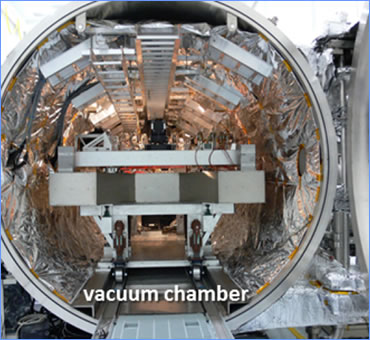
Three 1350 lb
capacity Vacuum Minus K
SM-1s
for the
SCDU in JPL's testbed configuration.
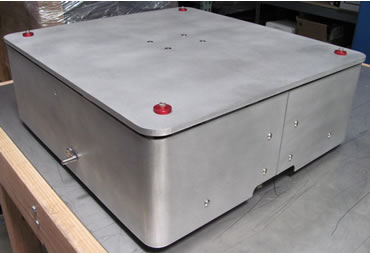
Minus K
BM-1
Vacuum Isolation
Modifications for
to the isolators based on your application requirements could include:
• Use of Stainless Hardware
• Removal of Paint and/or Powder
Coating
• Removal of Anodizing
• Replacement of Nylon or
Plastic Parts
• Electroless Nickel on Steel Parts
• Venting
Blind Holes
• Use of Vacuum Grease for Low Outgassing
• Bare
Aluminum
• We'll need to provide custom pricing for vacuum
applications. The price is typically 3 times the standard units for vacuum
compatible (internal chamber) placement.
|
|
|
|
|
|
|
|
More at Vacuum
Chamber Isolation Page...
|
|
Standard
and Custom Vibration Isolation with Better Performance than Active Systems
Cutting Edge Vibration Isolation for use in...
|
|
|
|
|
Previous
Newsletters
|

 |
|
|