|
|
Newsletter February 2026 | Menu of
Newsletters
Vacuum
Chamber Vibration Isolation
Minus K
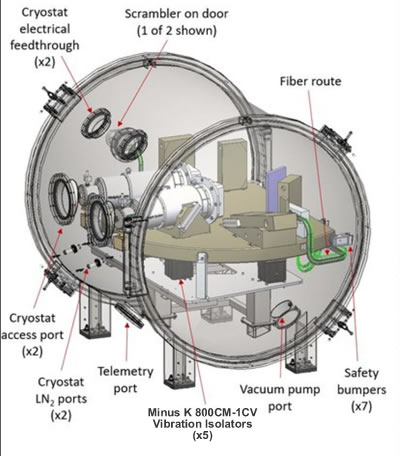
vibration isolation systems can be made vacuum compatible so they can be used
right inside vacuum chambers. In addition to their superior vibration
isolation performance, this offers other advantages of much lower payload
weights, more compact systems, and eliminates problems associated with vacuum
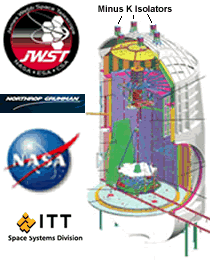
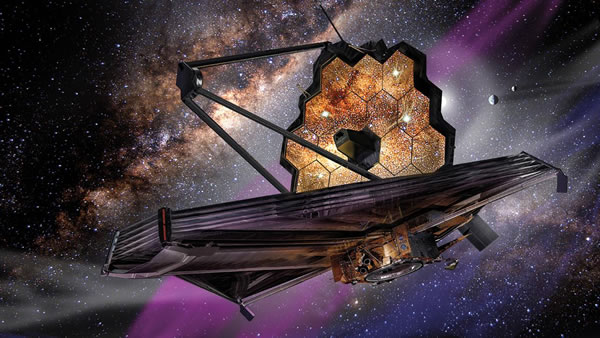
chamber feed-throughs. See below example with NASA/JPL SIM Interferometer
Testbed Spectral Calibration Development Unit (SCDU).
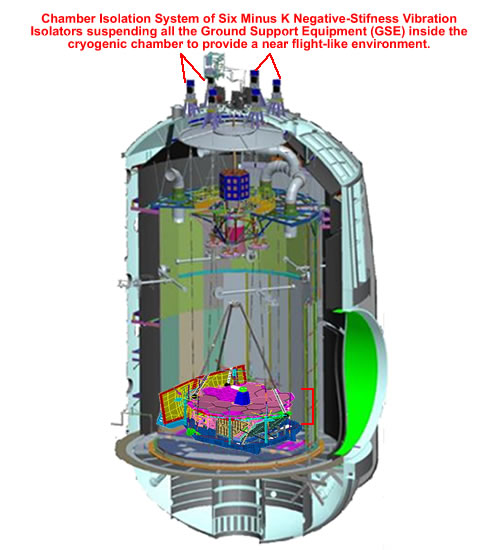
Our vibration
isolation systems have also been used to support entire vacuum chambers.
This offers the advantages of more standard designs and lower costs in some
cases. |
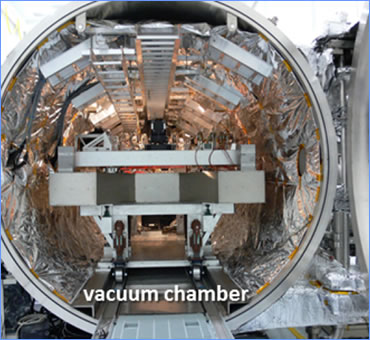
Three 1350 lb
capacity Vacuum Minus K
SM-1s
for the
SCDU in JPL's testbed configuration.
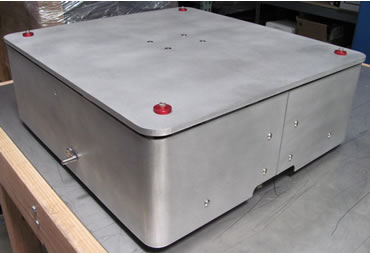
Minus K
BM-1
Vacuum Isolation
Modifications for
to the isolators based on your application requirements could include:
• Use of Stainless Hardware
• Removal of Paint and/or Powder
Coating
• Removal of Anodizing
• Replacement of Nylon or
Plastic Parts
• Electroless Nickel on Steel Parts
• Venting
Blind Holes
• Use of Vacuum Grease for Low Outgassing
• Bare
Aluminum
• We'll need to provide custom pricing for vacuum
applications. The price is typically 3 times the standard units for vacuum
compatible (internal chamber) placement.
|
|
|
|
|
|
|
|
More at Vacuum
Chamber Isolation Page...
|
|
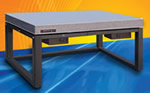
Featured Product: SM-1 Large
Capacity, Low Frequency Vibration Isolators
- Vertical natural
frequency of 1/2 Hz or less can be achieved over the entire load range.
- Horizontal natural
frequency is load dependent. 1/2 Hz or less can be achieved at or near the
nominal load.
- See typical
transmissibility curve
Performance
for the SM-1.
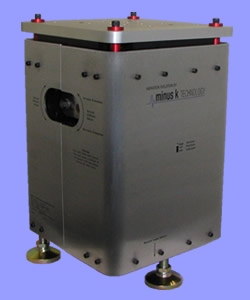 Minus K's
SM-1
is low frequency vibration isolator for weight loads from 500 to 4200 lbs. and
1/2 Hz performance vertical and horizontal. Minus K's
SM-1
is low frequency vibration isolator for weight loads from 500 to 4200 lbs. and
1/2 Hz performance vertical and horizontal.
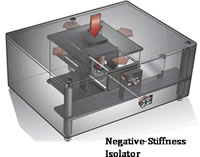
The SM-1 negative-stiffness
isolator is the basic building block of the
FP-1
Floor Platform and other heavy multiple isolator systems. They require no air
or electricity.
This isolator has the same basic features of our all
passive, negative-stiffness, manually-adjustable bench top isolators. It offers
our very-low frequency isolation performance for payloads of many thousands of
pounds.
SM-1
isolator can be used alone or with any number of additional units to achieve
higher capacity systems. They can be arranged in many geometrical
configurations to suit your application.
The
SM-1
isolators can also be placed on pedestals to increase the height of the
isolation system.
Pricing &
Specifications
| |
|
|
|
Seismometer Vibration
Isolation
Satellite
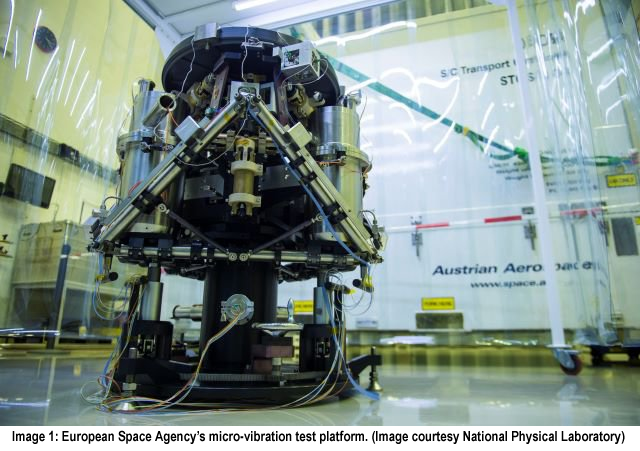
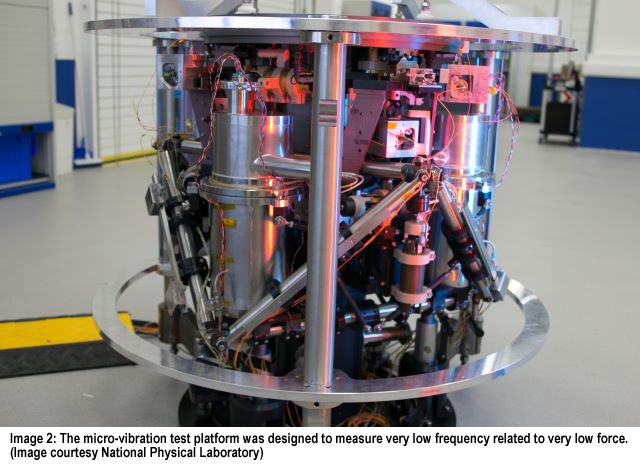
Micro-Vibration Test Platform Integrates Negative-Stiffness Vibration Isolation
with Active Seismometers to Isolate Vibrations to 0.1 Hz.
|
Developed by the
National Physical Laboratory for the European Space Agency, the micro-vibration
platform is used to measure internal vibrations, and to test satellite
components under a range of controlled vibration conditions to ensure that they
can operate correctly in a satellite environment without affecting other
sensitive systems. The platform is so sensitive it can measure the force of a
single dropped feather, and significantly reduce the effects of vibrations
coming from waves of the nearby North Sea.
The European Space Agency
(ESA) has added a micro-vibration test instrument, developed by the National
Physical Laboratory (NPL), to its satellite testing facilities. NPL is the
UK’s National Measurement Institute, developing and maintaining the
national primary measurement standards. The instrument measures vibrations
generated by satellite subsystems, to quantify their effects on images and
measurements made from space. This facility is the result of five years of
collaboration between NPL and ESA.
 |
Vibrations onboard a
satellite can be caused by common instruments and mechanisms, such as spinning
reaction wheels, solar array drives and rotating cryocoolers. ESA needed to be
able to measure and correct for these jitters and vibrations to improve the
accuracy of its Earth observations. This required the simulation of satellite
components under a range of controlled vibration conditions.
“The
NPL won a tender to design a system for the European Space Agency which
required a very high level of performance,” said Dan Veal, Senior Research
Scientist with the National Physical Laboratory in the United Kingdom.
“The system was required to measure very low frequency related to very low
force. ESA needed a better way to check satellite components for these
micro-vibrations, and to what effect they might disrupt a
spacecraft.”
 |
Measurement
Platform Supported by a Vibration Isolation Platform: “NPL developed a
platform which is able to characterize any force produced by a satellite
component weighing up to 150 pounds,” added Veal.
The
micro-vibration platform can measure vibrations to an unprecedented degree of
accuracy. It is so sensitive it can measure the force of a single dropped
feather. Sometimes housed in a vacuum chamber to simulate space conditions,
when used in air the system is enclosed in a tent to limit perturbations caused
by airflow. The platform is built as a structure of two main levels: 1) a lower
vibration isolation platform to cancel disturbances coming from the ground; and
2) an upper measurement platform...
Full
article...
|
|
|
|
Standard
and Custom Vibration Isolation with Better Performance than Active Systems
Cutting Edge Vibration Isolation for use in...
|
|
|
|
|
Previous
Newsletters
|

 |
|
|