
Medical Design Briefs - September 2026
Leveraging Graphene Quantum Dots for Sensing Neurological Disorder-Related Analytes in Blood
Unique molecular fingerprints act as an indicator for neurological, psychiatric and endocrine disorders.
Since Graphene quantum dots (GQDs) are small zero-dimensional nanoparticles, essentially fragments of graphene, with lateral dimensions typically less than 10 nm and thicknesses of just a few atomic layers. The electronic structure of GQDs is influenced by their size, shape, and edge configurations, leading to tunable electronic and optical properties. Their surface can be easily functionalized with various chemical groups, allowing for tailored properties and interactions with other molecules.
Unlike many other quantum dots, GQDs are generally considered biocompatible and non-toxic, making them suitable for biomedical use, with significant potential in various therapeutic applications. They exhibit strong and tunable photoluminescence, meaning they can emit light of different colors when excited by light of a specific wavelength. This property is crucial for bioimaging and biosensing, making GQDs some of the most promising carbon-based nanomaterials at the forefront of research for sensing hormones and neurotransmitters.
GQDs: Detecting Hormones and Neurotransmitters in Blood
Due to the proliferation of cancer rates, cardiovascular diseases, neurodegenerative disorders, and autoimmune diseases, it is essential to introduce strategies that can rapidly and specifically detect the ultralow concentrations of relevant biomarkers, pathogens, toxins and pharmaceuticals in biological matrices. Consequently, research works have become necessary to fabricate biosensors for their early diagnosis and treatment, using nanomaterials like GQDs.
One of these research projects is being conducted by a bioresearch group at Texas Christian University’s campus in Fort Worth, TX. Led by Alina Valimukhametova, PhD, with the university’s physics and astronomy department, the project focuses on the development of improved methods for sensing hormones and neurotransmitters at low concentrations in the blood.
“My primary research lies in the area of carbon nanomaterials and their applications in biophysics,” says Valimukhametova. “Remarkable properties of carbon nanotubes and graphene quantum dots open new perspective for their applications in drug transport and biological imaging and sensing. My particular interest is to develop a new sensor for early neurological, psychiatric and endocrine disorders detection, using only infrared light emission from GQDs as an indicator of hormone and neurotransmitter dysregulations in blood,” she says.
“The fluorescence of the GQDs upon interaction with these molecules undergoes changes, allowing for unique molecular fingerprints for different analytes. Artificial intelligence will detect patterns in the quenching or shift in emission peaks after exciting GQDs with near-infrared fluorescence in the presence of serotonin, dopamine, cortisol, and oxytocin.”
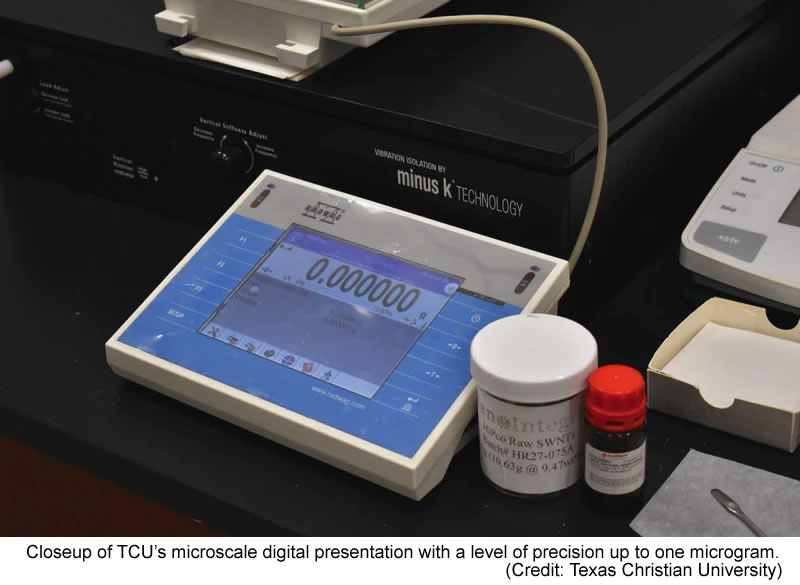
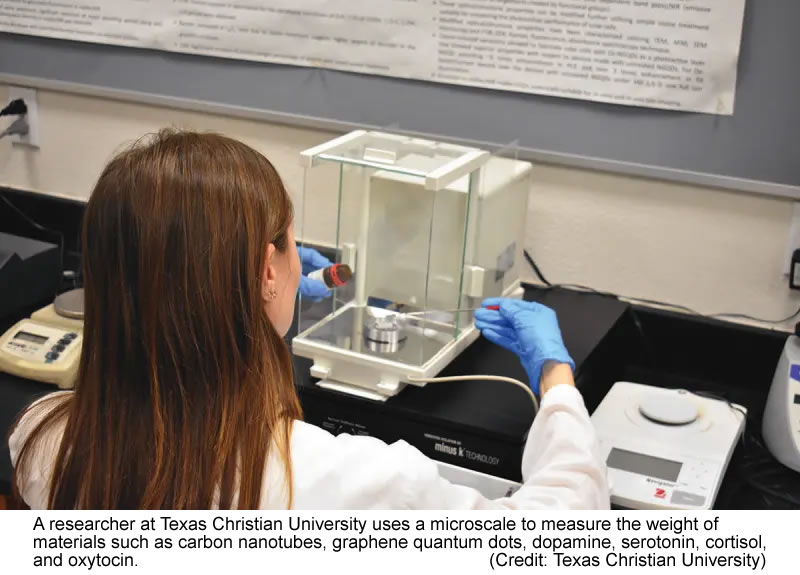
Since the concentration of these hormones and neurotransmitters in blood is very small, for precise measurements Valimukhametova utilizes a microscale with a level of precision of up to one microgram to measure the weight of the materials, such as carbon nanotubes, graphene quantum dots, dopamine, serotonin, cortisol, and oxytocin.
Need for Vibration Isolation
“A microgram is a very small mass, so any external vibrations would contribute to a change in the readings,” explains Valimukhametova. “Use of an optical table was not resolving the problem. What did solve the vibration issue was negative-stiffness vibration isolation, which provided the needed improvement in inhibiting the external vibrations so we could perform accurate measurements on the microscale.”
Introduced in the mid-1990s by Minus K Technology, negative-stiffness vibration isolation has been widely accepted for vibration-critical applications, largely because of its ability to effectively isolate lower frequencies, both vertically and horizontally. The company’s isolators are used by more than 300 universities and government laboratories in 53 countries.
Negative-stiffness isolators are unique in that they operate purely in a passive mechanical mode. They do not require electricity or compressed air. There are no motors, pumps, or chambers, and no maintenance because there is nothing to wear out.
“Vertical-motion isolation is provided by a stiff spring that supports a weight load, combined with a negative-stiffness mechanism,” says Erik Runge, vice president of engineering at Minus K. “The net vertical stiffness is made very low without affecting the static load-supporting capability of the spring. Beam-columns connected in series with the vertical-motion isolator provide horizontal-motion isolation. A beam-column behaves as a spring combined with a negative-stiffness mechanism. The result is a compact passive isolator capable of very low vertical and horizontal natural frequencies and high internal structural frequencies.”
Negative-stiffness isolators achieve a high level of isolation in multiple directions, with the flexibility of custom-tailoring resonant frequencies to 0.5 Hz vertically and horizontally (with some versions at 1.5 Hz horizontally)*. When adjusted to 0.5 Hz, the isolators achieve approximately 93 percent isolation efficiency at 2 Hz, 99 percent at 5 Hz, and 99.7 percent at 10 Hz. (*Note that for an isolation system with a 0.5 Hz natural frequency, isolation begins at 0.7 Hz and improves with increase in the vibration frequency. The natural frequency is more commonly used to describe the system performance.)
GQDs and Cancer Research
The lab’s research is providing insight into the mechanisms of GQD interaction with cell membranes of healthy and cancer cells. The optimization of these mechanisms can serve for the enhancement of a variety of novel GQD applications in biomedicine including therapeutic delivery and disease detection through sensing as well as diagnostic imaging.
This article was written by Jim McMahon, who writes on industrial, manufacturing, and technology issues. For more information, contact Alina Valimukhametova, PhD candidate, Biophysics Department, Texas Christian University, Fort Worth, TX, at a.valimukhametova@tcu.edu
For more information on negative-stiffness isolators, contact Steve Varma, Minus K Technology, Inc., Inglewood, CA, at request@minusk.com
|