Negative-Stiffness Vibration Isolators
How Do They Work
Minus K® vibration isolators employ a revolutionary
concept in low-frequency vibration isolation. Vertical-motion
isolation is provided by a stiff spring that supports
a weight load, combined with a negative-stiffness mechanism
(NSM). The net vertical stiffness is made very low without
affecting the static load-supporting capability of the
spring. Beam-columns connected in series with the vertical-motion
isolator provide horizontal-motion isolation. The horizontal
stiffness of the beam-columns is reduced by the "beam-column"
effect. (A beam-column behaves as a spring combined with
an NSM.) The result is a compact passive isolator capable
of very low vertical and horizontal natural frequencies
and very high internal structural frequencies.
Minus K® isolators typically use three isolators stacked
in series: a tilt-motion isolator on top of a horizontal-motion
isolator on top of a vertical-motion isolator. A vertical-motion
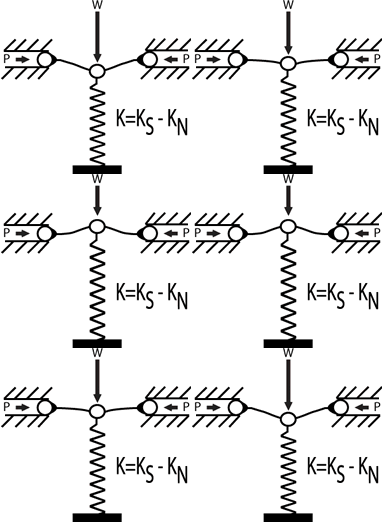
isolator is shown in Figure 1. It uses
a conventional spring connected to an NSM consisting of
two flexures connected at their inner ends to the spring
and supported at their outer ends, and loaded in compression
by forces P. The spring is compressed by weight W to the
operating position of the isolator, as shown in Figure
1. The stiffness of the isolator is K=KS-KN where KS is the spring stiffness and KN is the magnitude of a negative stiffness which is a function
of the design of the flexures and the load P. The isolator
stiffness can be made to approach zero while the spring
supports the weight W.
Figure 1
A horizontal-motion isolation system consisting of two beam-column isolators is shown in Figure 2. Each isolator behaves like two fixed-free beam columns loaded axially by a weight load W. Without the weight load the beam-columns have horizontal stiffness KS. With the weight load the lateral bending stiffness is reduced by the "beam-column" effect. This behavior is equivalent to a horizontal spring combined with an NSM so that the horizontal stiffness is K=KS-KN, and KN is the magnitude of the beam-column effect. Horizontal stiffness can be made to approach zero by loading the beam-columns to approach their critical buckling load.
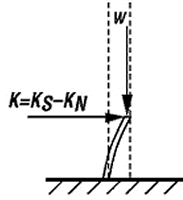
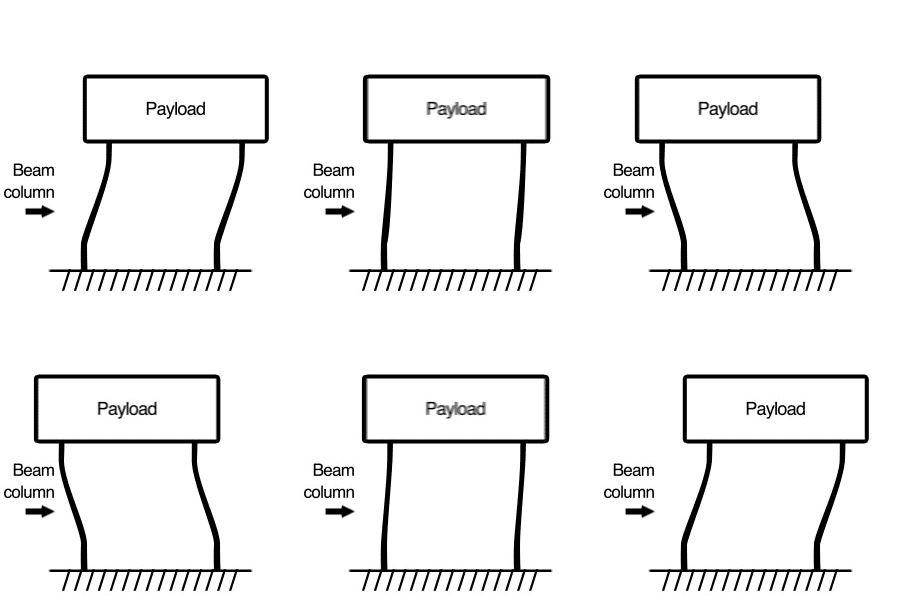
Figure 2
Figure 3 shows a schematic of a negative-stiffness vibration isolator incorporating the isolators of Figures 1 and 2. A tilt pad serves as the tilt-motion isolator. A vertical stiffness adjustment screw is used to adjust the compression force on the negative-stiffness flexures thereby changing the vertical stiffness. A vertical load adjustment screw is used to adjust for varying weight loads by raising or lowering the base of the support spring to keep the flexures in their straight, unbent operating position. This feature can be automated in single-isolator systems and to achieve automatic leveling in multiple-isolator systems.
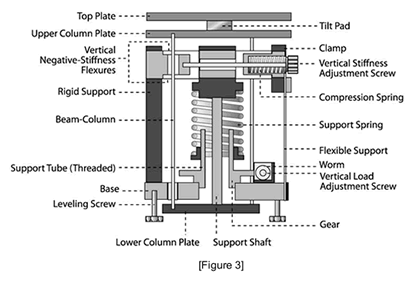
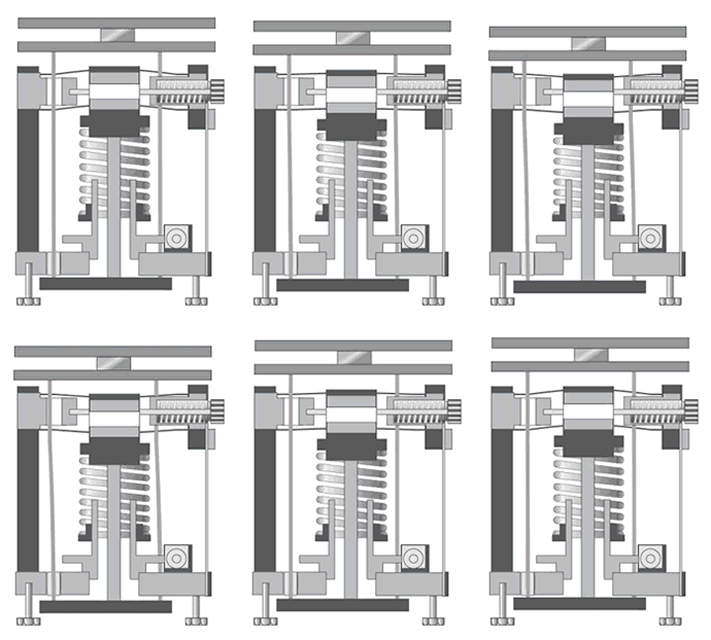
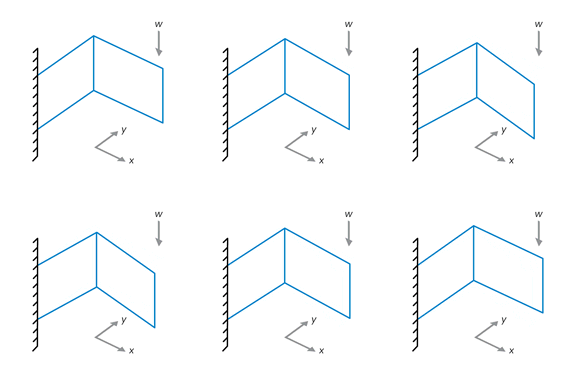
Figure 4 Shown is a schematic of a typical cantilevered horizontal-motion flexure that permits a low isolator height and low horizontal natural frequencies; bearing a weight load W on its end, the flexure has x and y displacement capability.