
SPIE International Society of Optical Engineering Online - November 2008
Negative-stiffness vibration isolation in laser and optical systems
David L. Platus
A passive mechanical approach to minimizing motion makes it possible for sophisticated instruments such as scanning probe microscopes to operate in environments that would otherwise not be practical.
Traditionally, large air tables have been the isolators used for laser and optical equipment. The ubiquitous passive-system air tables, adequate up until a few years ago, are now being seriously challenged by the need for more refined imaging requirements. Bench-top air systems, however, provide limited isolation vertically and very little isolation horizontally. Yet scanning probe microscopes (SPMs), for example, have vibration isolation requirements that are unparalleled in the laser and optical world. For most SPMs, the vertical axis is the most sensitive. These instruments can also be quite sensitive to vibrations in the horizontal axis. To meet this challenge, so-called negative-stiffness mechanism (NSM) isolators are able to custom- tailor resonant frequencies both vertically and horizontally,(2) providing increased isolation performance for SPMs over air tables.
Laser-based interferometers represent another kind of extremely sensitive device that is capable of resolving nanometer-scale motions and features. The sophisticated modern ellipsometry techniques that allow this high performance rely on low noise to be able to detect fringe movement. Properly isolating an interferometer will allow it to provide the highest possible resolution. But interferometers and other optical systems are often quite complex. They have long optical paths that can lead to angular magnification of vibrations. Air tables can make the problems worse since they have a resonant frequency that often matches that of floor vibrations, typically 2-3Hz. And their isolation efficiency is quite limited below about 8Hz. NSM isolators provide isolation in these environments where air tables simply cannot.
What negative-stiffness isolators provide is genuinely unique to the field of laser and optical systems, in particular, transmissibility: that is, the vibrations that transmit through the isolator relative to the input vibrations (see Figure 1). Transmissibility with negative-stiffness is substantially improved over air systems, and even over active isolation systems. Also known as electronic force cancellation, this approach uses electronics to sense motion and then adds forces electronically to effectively cancel out or prevent it. The efficiency of active isolation systems is adequate for application with the latest lasers and optics, as they can start isolating as low as 0.7Hz. But because they run on electricity, they can be negatively influenced by problems of electronic dysfunction and power modulation, which can interrupt scanning.
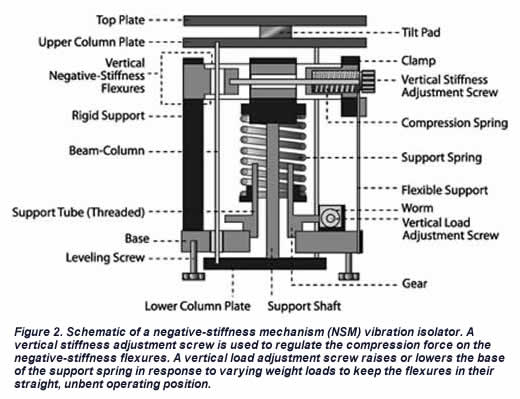
Negative-stiffness isolators employ a completely mechanical concept in low-frequency vibration isolation. Vertical-motion isolation is provided by a stiff spring that supports a weight load, combined with an NSM. The net vertical stiffness is made very low without affecting the static load-supporting capability of the spring (see Figure 2). Beam columns connected in series with the vertical-motion isolator provide horizontal-motion isolation. The horizontal stiffness of the beam columns is reduced by the 'beam-column' effect. (A beam-column behaves as a spring combined with an NSM.) The result is a compact passive isolator capable of very low vertical and horizontal natural frequencies and very high internal structural frequencies. The isolators (adjusted to 1/2Hz) achieve 93% isolation efficiency at 2Hz, 99% at 5Hz, and 99.7% at 10Hz.(3)
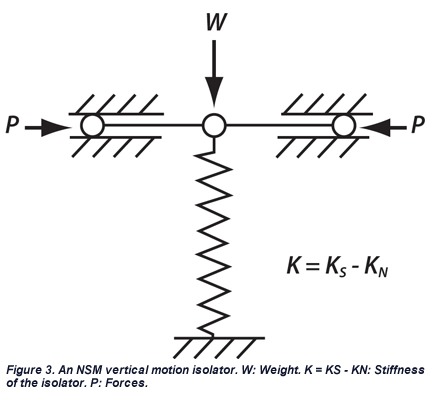
NSM isolators typically use three isolators stacked in series: a tilt-motion isolator, on top of a horizontal motion isolator, on top of a vertical-motion isolator. A vertical motion isolator (see Figure 3) uses a conventional spring connected to an NSM consisting of two bars hinged at the center, supported at their outer ends on pivots, and loaded in compression by forces P. (The hinged bars are for illustration only. Flexures are used in the isolators to avoid stiction and friction.) The spring is compressed by weight W to the operating position of the isolator. The stiffness of the isolator is K = KS - KN, where KS is the spring stiffness and KN is the magnitude of a negative stiffness, which is a function of the length of the bars and the load P. The isolator stiffness can be made to approach zero, while the spring supports the weight W.
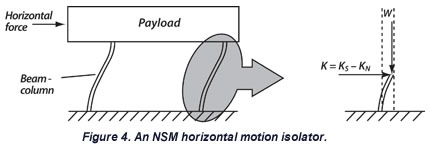
A horizontal-motion isolation system is illustrated by two beam-column isolators (see Figure 4). Each isolator behaves like two fixed-free beam-columns loaded axially by a weight load W. Without the weight load, the beam-columns have horizontal stiffness KS. With the weight load, the lateral bending stiffness is reduced by the beam-column effect. This behavior is equivalent to a horizontal spring combined with an NSM so that the horizontal stiffness is K = KS - KN, and KN is the magnitude of the beam-column effect. Horizontal stiffness can be made to approach zero by loading the beam-columns to approach their critical buckling load.
As industry and universities continue to broaden their laser and optical research and to devise applications necessitating more sensitive equipment and expanded lab facilities, vibration-handicapped environments will become more prevalent. A better vibration isolation solution will be required than has been available up to now. NSM vibration isolation is a highly workable solution and costs significantly less than conventional alternatives: up to one-third the price. Improvements in our negative-stiffness technology will continue with the addition of new standard bench top and workstation configurations to accommodate additional laser and optical systems. For example, the BM-1 bench top platform capacity was recently increased to 1000lb, and a new stand for the BM-1 platform will offer a compact workstation to conserve valuable laboratory space with approximate dimensions of 24×24×30in.
David Platus
Minus K Technology
Inglewood, CA
https://minusk.com
David L. Platus is the inventor of NSM vibration isolation systems, and president and founder of Minus K Technology, Inc. He earned a BS and a PhD in engineering from the University of California, Los Angeles, and a diploma from the Oak Ridge School of (Nuclear) Reactor Technology. Prior to founding Minus K Technology, he worked in the nuclear, aerospace, and defense industries, conducting and directing analysis and design projects in structural-mechanical systems. He became an independent consultant in 1988. He holds over 20 patents related to shock and vibration isolation.
References:
1. D. K. Ferry, Negative-stiffness vibration isolation improves reliability of nanoinstrumentation, Laser Focus World 43, no. 10, pp. 107, 2007.
2. D. L. Platus, Negative-stiffness-mechanism vibration isolation systems, Proc. SPIE 3786, pp. 98-105, 1999.doi:10.1117/12.363841
3. https://minusk.com/content/technology/performance Minus K Technology performance results. Accessed 28 October 2008.