
Mechanical Engineering - March 2007
Fine-Tuning
It In our age of MEMS. microsurgery, nanotechnology, and general pursuit of minute mechanical marvels, even the smallest vibration can become a big nuisance. For instance, people in quality control actually have to examine the microchips and tiny accelerometers that factories turn out.
 Aiming to get a bigger piece of the action, the marketer of a passive vibration-canceling system has struck a deal with a manufacturer of isolation workstations to offer a product that will combine both companies' abilities.
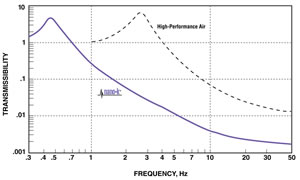
Low profile: Minus K publishes a graph that compares the low-frequency, vibration-canceling curve of its half-hertz negative-stiffness isolator with the profile of a pneumatic system tuned to about 2.5 Hz.
Minus K Technology Inc. in Inglewood. Calif., has a passive system that isolates equipment from low-frequency vibration. It is collaborating with a maker of vibration-canceling workstations, Kinetic Systems Inc. in Boston. Their products are used in laboratories and by manufacturers.
Kinetic Systems has been making electronic and pneumatic vibration isolation workstations since the 1970s, according to senior sales engineer Larry Shaver. The new workstation, designated MK26, is the company's first to use the system from Minus K.
Kinetic Systems has been making electronic and pneumatic vibration isolation workstations since the 1970s, according to senior sales engineer Larry Shaver. The new workstation, designated MK26. is the company's first to use the system from Minus K.
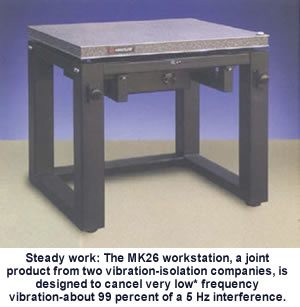 David Platus, president of Minus K, said his company has been selling its vibration-canceling system to manufacturers of other devices, such as atomic force microscopes, and has been offering it in a workstation for some time. Platus pointed out that this will be the first time the company has marketed its negative-stiffness isolator as part of a general-purpose workstation with a choice of either honeycomb or other tabletop and the variety of options that are available for the MK26.
As Minus K describes it, its vibration damping system uses a spring that supports a load in concert with a negative-stiffness mechanism to cancel vertical vibration. Beam columns combined in series cancel horizontal vibration.
The natural frequency of the system is usually tuned to one-half hertz. As a result of the low resonant frequency, the surface of the workstation is isolated from 99 percent of a 5 Hz vibration and from 99.7 percent of 10 Hz. A video on Minus K's home page showcases a desktop product, called 25BM-4, which is tuned to half a hertz. Two wine glasses are on a table subject to a 5 Hz vibration with an amplitude of about a millimeter, the company says. One, almost still, is isolated; the other, almost spilling, is not. There are also a couple of coins balanced on edge on the vibration isolation platform.
The Web site also has a "Technology" section that explains how the company's isolation systems work.
The MK26 workstation consists of a Kinetic Systems frame with a tabletop resting on the Minus K vibration isolation device. The product is sold by both companies.
The stations are available in two sizes-30x36 inches and 36x48 inches-and in a range of weight capacities up to 650 pounds. They can come with options, including enclosures, guardrails, monitor stands, and Faraday cages to block electromagnetic interference, which will raise the price. The basic workstation starts around $7.000.