
Laboratory Design - February 2007
Tech Tip
Negative-Stiffness vibration isolation adds option for nanotech instrument isolation
Not so long ago, deciding where to locate a scanning probe microscope was simple: put it in the basement where the ambient vibration was minimized. But recently, with nanotechnology applications growing exponentially, scientists and engineers are putting equipment in a multitude of locations where vibration noise is significantly high. Scanning probe microscopes, interferometers, and stylus profilers are being sited in locations that pose a serious challenge to vibration isolation.
Additionally, in an effort to keep their nano-equipment costs as low as possible by cutting out the peripherals, many academics and industries are not adequately providing for vibration isolation. Although high-budget installations typically incorporate adequate vibration isolation, this is not the case with many lesser-budget set-ups (those spending under $120,000 for equipment), which ironically represents the area of most rapid growth in the nanotechnology universe. It is estimated that 40 to 50% of these sites, in both academia and industry, are initiated with inadequate vibration isolation.
The above scenario is influenced by the fact that those specifying nano-equipment do not always fully grasp the instruments' sensitivity and requirements for proper site selection and vibration isolation. Without appropriate isolation, instruments are likely to produce diffused and fuzzy imaging, and sometimes no image at all, resulting in reduced operability of a facility's nano-equipment.
"Vibration isolators are one of those necessities that people are not really focused on when they go to purchase an instrument like an AFM [atomic force microscope]," says George McMurtry, CEO of NanoAndMore USA Inc. (www.nanoandmore.com), a distributor of AFM probes and nanotechnology peripherals. "But it is different with the bigger scanning electron microscopes and transmission electron microscopes, because you are dealing with a very expensive piece of gear that technically needs all sorts of isolation in order to work properly. They are more apt to talk about it right up front.
"When you get into the smaller instruments like white light interferometers, laser interferometers, stylus profilers, and atomic force microscopes, then you get problems with site preparation. In many cases there is not a lot of site prep done, despite the fact that they may be sitting on the fourth floor of a building, and without isolation will end up getting really poor images"
McMurtry adds, "When we are talking on the phone with clients, they ask us what probe will solve a specific problem that they are experiencing. Sometimes no probe will solve the problem-they first have to solve their noise problem. And that means looking at some sort of mechanical isolation."
As instrumentation gets more and more complex, and measurements are being done at a smaller and smaller level, those vibrations that are present will start to dominate, and the need for more effective isolation increases. Isolators have been used since atomic force microscopes were introduced in the 1980s, but there weren't that many AFMs then, and most of them were in basements. The use of nano-instrumentation has grown dramatically and the need for increased isolation has followed that trend.
"There are so many more people using AFMs in so many different environments that isolators are needed more often," says Mark Flowers, president of Nanoscience Instruments Inc. (www.nano science.com), a distributor of atomic force microscopy products. "In the early days you could put your AFM in the basement of your building; now people want to use their AFMs on the third floor. But in the basement you are going to have a much better environment, and you could get by with an unsophisticated isolator."
Flowers adds, "Many times the consumer is unaware of the need for isolation. We discuss with the user the type of environment the equipment will be going into, what applications they are going after, and then determine what they will need in an isolator. For example, we are seeing a great growth in the education market. There are a lot of initiatives out there to expose undergraduates and high school students to nanotechnology. But they don't necessarily know what they need to sustain proper isolation."
 High potential for problems
Vibration issues are often non-obvious to the human senses, but can cause considerable noise and disturbance to an AFM or interferometer. The noise is caused by a multitude of things, and can originate from many locations. Building location and age have a strong impact on the scenario, as do surrounding features (roads, railroads, other buildings, wind, construction, etc.).
Within the building itself are additional vibration sources, such as the heating and ventilation system, fans, pumps that are not properly isolated, and elevators. Depending on how far away the instruments are from the vibration sources, they may or may not be adversely affected.
These internal and external influences cause low frequency vibrations, which raise havoc with nano-instrumentation. The wind, for instance, can cause a building to sway at around 2 Hz, and cause a substantial resonance. A train near the building can cause movement in the cement slab-negligible for occupants but disastrous for instruments.
Experiments attempting to measure a very few angstroms or nanometers of displacement, require an absolutely stable surface upon which to rest an instrument. If building vibration is transferred to the instrument, the desired science may be completely impossible to perform.
Building construction methods and isolator equipment can both be used to solve a problem, and of course the scope of the problem determines the solution. If the building is not new construction, or scheduled for a retrofit, the scientist must seek an equipment-based isolation method to accommodate the instrumentation in the existing facility.
Since the 1960s air tables have been used for isolation. Basically cans of air, they are still the most popular isolators used. But air tables with resonant frequencies at 2 to 2.5 Hz can typically only handle vibrations down to about 8 to 10 Hz-not quite low enough for optimum performance with modern nano-equipment. For purposes of clarity in scanning probe microscopes and interferometers, air tables are an inefficient isolation solution.
As some may recall from the early years of nanotechnology, research scientists were fond of suspending their very expensive AFMs from bungee cords hanging from the ceiling, and achieved acceptable vibration isolation. Although some are still employing this technique, these numbers are dwindling; understandably, many aren't willing to take that risk any longer, and have switched over to other types of isolation systems.
Isolation methods
One of those is active isolation, also known as electronic force cancellation. Active isolation uses electronics to sense the motion, and then generates equal amounts of motion electronically to compensate, effectively canceling out the motion. Their efficiency is fine for applications with the latest nanotechnology, as they can start isolating as low as 0.7 Hz, quite sufficient for isolating the lower frequencies that are so damaging to image clarity with SPMs and interferometers.
However, if you can get things mechanically isolated without having to use energy, such as in the form of electricity, then you are inherently better off. If you don't have to supply energy to run your isolator, you will not be so negatively influenced by power modulations or malfunctions, which can interrupt scanning.
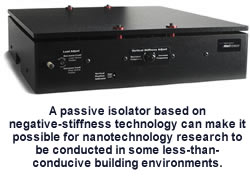
Negative-stiffness vibration isolation systems have become a growing choice for nanotechnology applications. Not only are they a highly workable vibration solution, but their cost is significantly less (up to one-third the price of active systems).
"This is a passive approach for achieving low vibration environments and isolation against sub-Hertz vibrations," says David L Platus, inventor of negative-stiffness mechanism vibration isolation systems, and president and founder of Minus K Technology Inc. (www.minusk.com). "These isolation systems enable vibration-sensitive instruments, such as scanning probe microscopes, micro-hardness testers, and scanning electron microscopes, to operate in severe vibration environments, such as upper floors of buildings and cleanrooms. The images and data produced are many times better than those achievable with pneumatic isolators."
Negative-stiffness isolators employ a unique-and completely mechanical-concept in low-frequency vibration isolation. Vertical-motion isolation is provided by a stiff spring that supports a weight load, combined with a negative-stiffness mechanism (NSM). The net vertical stiffness is made very low without affecting the static load-supporting capability of the spring. Beam-columns connected in series with the vertical-motion isolator provide horizontal-motion isolation. The horizontal stiffness of the beam-columns is reduced by the "beam-column'1 effect. (A beam-column behaves as a spring combined with an NSM.)
The result is a compact passive isolator capable of very low vertical and horizontal natural frequencies and very high internal structural frequencies. The isolators (adjusted to 0.5 Hz) achieve 93% isolation efficiency at 2 Hz; 99% at 5 Hz; and 99.7% at 10 Hz.
"Improved vibration isolation directly correlates to improved instrument performance," says Patrick O'Hara, president/CEO of Ambios Technology Inc. (www.ambiostech.com), a manufacturer of SPMs, stylus profilers, and optical interferometers used in nanotechnology. "When you are trying to measure atomic-scale features, mechanically stable support structures are critically important. Up until the advent of probe microscopes, and some of the other very high-resolution imaging and data acquisition techniques, air isolators were adequate for most applications. But not any longer."
According to O'Hara, the negative-stiffness technology is unique. "In particular, the transmissibility of a negative-stiffness isolator-that is the vibration that transmits through the isolator as measured as a function of floor vibrations-is substantially improved over air or active isolation systems. Although active isolation systems have fundamentally no resonance, their transmissibility does not roll off as fast as negative-stiffness isolators. So, at building and seismic frequencies the transmissibility of active isolators can be 10X greater than negative-stiffness isolators. This causes substantial adverse measurement and imaging artifacts in the data. Air isolators have the added disadvantage that their 2 to 2.5 Hz resonance effects a significant loss in isolation capability below about 5 Hz. Negative-stiffness isolators are clearly the most efficient choice for probe microscopes."
Source: Minus K Technology Inc., a developer of vibration isolation products based on the company's patented negative-stiffness-mechanism technology. Minus K products, sold under the trade name Nano-K, are used in a broad spectrum of applications including nanotechnology, biological sciences, semiconductors, materials research, zero-g simulation of spacecraft, and high-end audio. The company is an OEM supplier to leading manufacturers of scanning probe microscopes, micro-hardness testers, and other vibration-sensitive instruments and equipment.