
Controlled Environments - January 2008
Vibration Isolation in Cleanrooms:
A System for Virtually Every Application
By: Hamid Shaidani
Vibration isolation workstations and related equipment are used in cleanrooms around the world to improve productivity for research and other high-precision work such as manufacturing semiconductors and optics. In general, the more precise the work, the more vibration control is required beneath it. Because such high-precision equipment must also match the appropriate class of cleanroom specifications, today's market offers a sometimes confusing array of vibration isolation products, many of which did not exist 20 years ago. With so many choices, it is important to match the equipment to the application.
Vibration isolation workstations for use in cleanrooms are typically designed to minimize horizontal surfaces and facilitate wipedown. Completely enclosed isolation modules and vented exhaust systems are also available to keep these workstations in compliance with cleanroom standards.
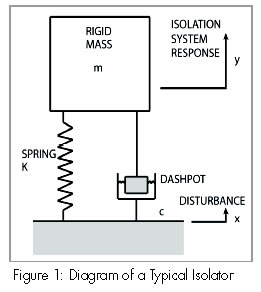
A simple vibration isolation system (Figure 1) can be represented as a mass, spring, and dashpot. The mass (m) is infinitely rigid. The spring is weightless, and its stiffness (k) can be measured in pounds per inch. The damper, or dashpot, is also weightless, and its damping coefficient (c) is typically measured in pounds per inch per second.
Most vibration isolation equipment is Class 1000 compatible, and Class 100 compatibility is also fairly common. Most manufacturers of this equipment make sure that certain models can be configured for Class 10 compatibility if the customer requests it. Equipment with Class 1 compatibility is harder to find across the board, but at least when you find it you know the pertinent attributes have not been "tacked on" but rather designed with only the specialized Class 1 market in mind.
EVERYTHING VIBRATES
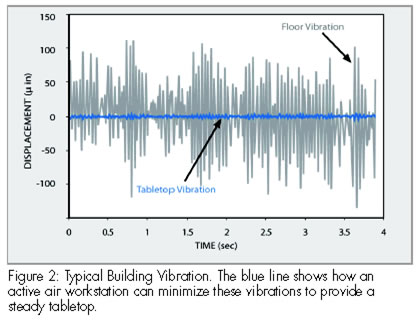
Because of traffic, machinery, HVAC systems, weather, and natural frequency, everything vibrates. In an average building, approximately 70-75% of the vibrations are vertical. In laboratories, vibrations don't have to be obvious for performance to suffer. Most vibrations are not even noticeable to a building's occupants, but many cannot be tolerated by equipment used in research, precision manufacturing, inspection, and quality control. Figure 2 shows typical building vibrations. Day-to-day problems may include excessive signal noise, low-frequency jitter, and high-resolution image blur. At their worst, uncontrolled vibrations can cause sensitive electromechanical and optical equipment to undergo excessive wear and even structural damage.
If you think you might need vibration control, you probably do. Most sensitive work benefits from vibration isolation equipment, and installation costs are minimal compared with the costs of discovering later, after your new operation or facility is up and running, that your product is flawed or production is stalled due to unwanted vibrations.
The two most important factors to consider in choosing vibration isolation equipment are natural frequency and isolation efficiency. The best systems achieve very low natural frequencies and attenuate all potentially damaging vibration amplitudes in the 8- to 200-Hz broadband, random-vibration spectrum. However, there are many variables, so it is best to consult an expert who can help you find the most appropriate equipment for your location and requirements. Some manufacturers offer on-site vibration surveys to ascertain those potentially damaging vibration amplitudes and frequencies.
Where vibration is a problem, modern vibration-control solutions are available. These range from relatively simple mounts and breadboards to highly efficient air systems, active electronic systems, and negative-stiffness systems constructed with technologies and materials that take them far beyond conventional vibration isolators, such as rubber blocks and metal springs. While blocks and springs may still have their places, the increased sensitivity of the latest laboratory equipment usually makes more sophisticated vibration isolation a must.
TYPES OF VIBRATION EQUIPMENT AVAILABLE FOR CLEANROOMS
 Breadboards
Many applications do not require a highly efficient vibration isolation workstation or, for that matter, any true vibration isolation at all. Certain prototyping, inspection, and assembly tasks only require reliable flat, stable surfaces. For these jobs, economical breadboards provide a solution.
On the market today are breadboards in larger variety than ever before. Many are constructed with precision tooling and high-quality materials. For instance, they may be bonded under pressure with vibration-damping, hightech structural epoxies. Available in many sizes and thicknesses with or without mounting holes, some are general purpose while others stress a particular feature such as a honeycomb-type core that lightens the weight of the board without sacrificing rigidity. Some breadboards offer nonmagnetic surfaces while others are magnetic. One type has a top skin of stainless steel and provides high static stiffness. Some can be ordered with custom cutouts.
Air Systems
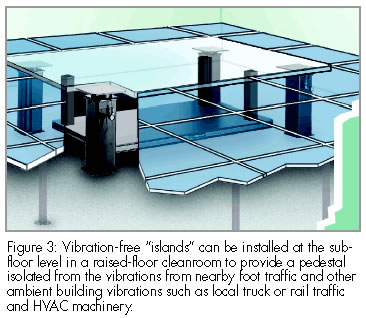
Many types of vibration-control equipment make use of passive or active air systems. In addition to a variety of workstations and benchtop platforms, these include modular mounts, platforms, and "islands" (Figure 3) for large equipment.
The Passive Air Systems
The first technology to advance vibration isolation beyond springs and blocks was a "passive" air system, which relies on manually adjustable air bladders ("air springs") replenished with a hand pump or a tank of compressed air. For a workstation or benchtop platform, passive air isolators offer high-frequency vibration isolation for less critical applications or wherever low-frequency vibrations below 10 Hz are not expected. These systems require manual leveling; when unwanted vibrations occur, they only damp the vibrations that are higher than the pre-set system frequency range.
Active Air Systems
"Active" air systems are self-leveling. Connected to a compressor or other pressurized air source, they have servo valves that automatically feed or bleed air from each isolator as needed to maintain the tabletop at a pre-set zero-deflection level as the load increases, decreases, or is moved. Vibration isolation efficiencies can approach 99% for vertical and 95% for horizontal.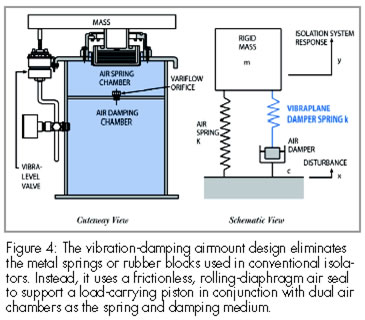 One type of active air system uses frictionless, rolling-diaphragm air seals (Figure 4) in conjunction with dual air chambers. With this design, stiffness is a function of the combined air volume of the dual chambers. Very low stiffness is needed to obtain the desired low natural frequency and thus high vertical isolation efficiency. Some systems even add pistons that enhance horizontal isolation.
Active air workstations are available in a wide range of payload capacities and tabletop sizes. Tabletops are typically constructed of aluminum, steel, or composite with plastic, anti-static, or stainless-steel laminate. Corrosion-resistant metals and layered composites can be combined to provide lightweight, rigid, highly damped surfaces. Although tabletops need to be supported by low-frequency support systems, the tops themselves should have high internal natural frequencies. Tabletops can be built with honeycomb-type cores of hexagonal cells for lighter weight without sacrificing rigidity. In fact, such cores can provide natural frequencies higher than those attainable with either ribbed cast iron or a solid granite block of the same size. Thick granite tabletops are also available.
Specialized Active Air Equipment
Small, personal workstations provide economical vibration isolation in small labs and other tight spaces. Table-tops may be constructed of steel with plastic laminate, anti-static laminate, or magnetic stainless-steel laminate.
Workstations for Class 1 cleanrooms are often constructed of welded, stainless-steel, tubular braces and may even use stainless-steel valves. The overall finish may be electropolish for Class 1 or clear passivate for Class 10. Tabletops may be electropolished stainless-steel laminate, white epoxy powder coat, or another impervious, easily cleaned surface. And so it goes with the applicable attributes of any other type of other clean-room-compatible vibration isolation equipment, including optical tables (and their legstands), breadboards, benchtop platforms, mounts, etc.
High-performance workstations can be easily customized with accessories and typically have tabletops made of composite with plastic laminate.
High-capacity workstations can handle heavy, tall, or moving loads and can be ordered with a variety of table-tops, including a granite slab that is 4" thick.
Variable-height workstations reduce user fatigue and back stress. These are remotely activated with a quiet electrohydraulic mechanism that allows the user to smoothly raise or lower the tabletop in order to maintain a posture that is ergonomically correct - a major benefit when accommodating different operators on different shifts.
Active air benchtop platforms are available with a wide range of efficiencies and a variety of platform surfaces (stainless steel, plastic laminate, etc.), with or without mounting holes. Some models offer horizontal as well as vertical vibration control.
Active air workstations provide stability for balances; confocal, tunneling, atomic-force, or optical microscopes; roundness checkers; surface profilometers; and other equipment used in tasks, such as cell injection, patch clamping, testing, inspections, wafer probing, and mask aligning in industries, such as medical research, semiconductor processing, telecommunications, and aerospace engineering.
Active air benchtop platforms enhance the performance of certain microscopes, microhardness testers, pro-filometers, balances, audio components, and other devices for which vibrations can be adequately controlled without a permanent table dedicated to that function.
Also available are mounts and platforms for large equipment weighing up to 20,000 pounds. These make use of passive and/or active air technology, and the ones with active air provide automatic leveling. For some large equipment, a raised-floor "island" - an alternative to corner lift brackets and poured-in-place isolation pads -can be built to provide vibration isolation for a section of a room.
Active Electronic Equipment
Active electronic equipment provides vibration isolation different from what is possible with air systems. Active electronic systems have microprocessors that use "active feedback" to sense vibrations and provide immediate responses to eliminate them. Rapidly and automatically adjusting to different loads, this type of system dynamically isolates all six translational and rotational modes of vibration.
Active electronic benchtop platforms provide a portable vibration isolation solution. Their tops can be ordered with or without mounting holes and can be constructed of aluminum plate, ferromagnetic stainless steel, plastic laminate, or anti-static laminate.
Up to 500 times stiffer than an air table, an active electronic workstation can easily accommodate a high-center-of-gravity or moving load. The best ones have ultra-low natural frequencies (< 1 Hz) and produce no low-frequency resonance. Available in a variety of load capacities and tabletops, they can actively damp vibrations from 1.0 to 1000 Hz, whether the vibrations originate from the building or from a piece of equipment on the platform. Isolation efficiency is especially efficient over 2 Hz, typically reaching 99% (40 dB) at 10 Hz. For frequencies above 1000 Hz, these workstations provide passive vibration control. For monitoring purposes, a multiplexed signal indicating vibration levels with and without isolation can be displayed on an oscilloscope.
Applications for active electronic benchtop platforms include the support of interferometers, SPM, and imaging microscopes. Active electronic workstations are for check-weighers, atomic force microscopes, micro-hard ness testers, profilometers, and other sensitive equipment
Negative-stiffness Equipment
Another type of vibration isolation workstation makes use of a stiff spring and a "negative-stiffness" mechanism to provide ultra-low natural frequencies, high internal structural frequencies, and excellent vertical and horizontal isolation efficiencies for static loads. Horizontal isolation is provided by beam columns connected series with a vertical-motion isolator. For supporting microscopes in semiconductor processing, aerospace engineering, medical research, and other fields, workstations can achieve superb vibration isolation: isolation efficiency at 2 Hz, 99% at 5 Hz, and 99.7% 10 Hz.
Optical Tables
In the field of optics, as in other sciences, the increased demand for precision has led to optical equipment that is ultra-sensitive to vibrations. These devices require high isolation capabilities at very low frequencies (2 and lower), with quick response to micro disturbances This performance can be achieved by vibration isolation support systems that incorporate a combination mechanical passive and active isolation concepts. A high quality optical table will offer quad-tuned as well broadband vibration damping using individual absorbers (tuned to the two lowest natural frequencies, bending and torsion, of each table) embedded in all four corners of the table. This is narrow-band selective damping, provided by four frequency-tuned, mass-spring resonators dry-damped and tuned to resonate 180° out of phase with the lowest natural frequency of the table. The out-of-phase inertial forces induced in each resonator mass act to cancel or absorb the motion of the table at its natural frequency and lower the resonant amplification.
CONCLUSION
Vibration isolation equipment performs at different efficiencies depending on payload. For the best performance, the weight of your typical load should be no more than 80% of the equipment's rated load capacity. For a workstation or support system, look for a manufacturer that offers equipment available in more than one load range. Some manufacturers also offer modular support systems that allow the retrofitting of workstations or optical tables to increase or decrease load capacity in the quest for greater accuracy.
Accuracy concerns are also related to ergonomics. There is no point in eliminating blur and jitter from microscope work, for example, if the operator cannot stay comfortable and alert. Good design and appropriate construction materials can make vibration isolation equipment user-friendly.
Many accessories are available to add convenience to workstations or optical tables, including shelves, drawers, laser ports, electrical outlets, monitor supports, lighting, guard rails, padded armrests, and retractable casters. Faraday cages protect sensitive operations from electromagnetic interference, while other tabletop enclosures are available for creating a draft-free, environmentally controlled atmosphere to protect against harsh manufacturing environments, etc. A typical aluminum-frame enclosure may have acrylic walls and a rigid composite roof onto which a HEPA filter blower can be mounted.
Vibration-control scientists continue to integrate new ideas into their products, but experience teaches that tomorrow's cleanrooms are likely to pose new vibration isolation challenges. Obviously, the right vibration isolation equipment for supporting a particular device or operation depends not only on the performance level and surface space required but also on the class of the cleanroom in which it will be used. Ongoing research holds the promise that we will be able to meet new challenges as they arise.