
Assembly Automation - April 2009
Feature
Vibration isolation theory and practice
Christine Connolly
Stalactite Technologies Ltd, Wakefield, UK
Purpose
The purpose of this paper is to review the different methods of isolating sensitive equipment from the effects of vibrations.
Design/methodology/approach
The passive mechanisms of springs and dampers, air tables, and negative stiffness are explained, and practical examples given. Next is a description of various active systems in which actuators respond in real time to feedback from motion sensors. Finally, some unusual and interesting applications are explored.
Originality/value
The paper points out a range of solutions to the engineer combating problematic metrology environments.
Findings
The need for vibration isolation is growing, because of increasing vibrations and the requirement for higher spatial resolution. Ingenious mechanical design allows passive systems to work with frequencies of the order of 1 Hz. Modern accelerometers detect absolute motion and allow disconnection from the vibrations of the floor. Applications include the stabilization of interferometric gravitational-wave detectors.
Introduction
Many instruments are sensitive to mechanical vibration and acoustic noise. These can arise from sources both outside and inside a building, from traffic and wind, heating, ventilation and air conditioning equipment, and production machinery. Vibration is becoming more prevalent as machine operating speeds increase and machine tools cut more deeply. Analytical balances, optical microscopes and other sensitive equipment in quality control laboratories must be isolated from vibration if they are to function correctly.
 At the nanoscale, vibration is even more of a problem. Nanoscale assemblies work at faster speeds and increase data storage capacity. They also access new physical properties governed by quantum effects, and produce novel devices. Vibration isolation equipment is standard kit in cleanrooms for the manufacture of semiconductors and optical components, microelectromechanical fabrication and nano assembly, protecting instruments such as interferometers, atomic force microscopes, optical tweezers and nanopositioning stages.
Several companies specialize in vibration isolation equipment, and many consult with the customer to advise on the most appropriate solution. There are active and passive approaches, and each technique has its strengths and weaknesses. Passive vibration isolation systems generate less heat than active systems, and this is an important consideration for instruments that suffer thermal drift.
Springs, dampers and air tables
The classical approach to vibration isolation uses a passive system of springs and dampers. The spring resists the movement of the vibration because it exerts an opposing force proportional to its displacement. The damper consists of a piston moving through a viscous fluid, or a conductor moving in a magnetic field, and it removes kinetic energy and dissipates it as heat. However, the spring has a natural resonant frequency that depends on its force constant k, and if the frequency of vibration approaches this natural frequency, the spring becomes an amplifier, This simple system does not work well with vibrations below about 10 Hz.
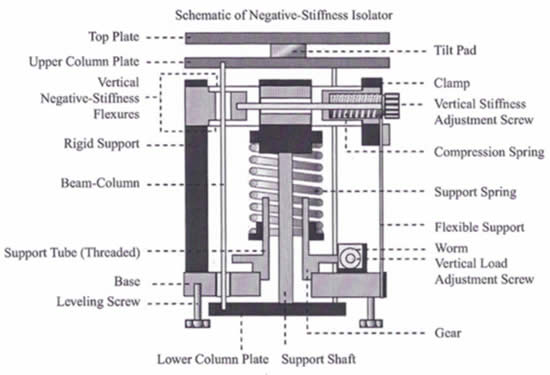
Figure 2: Minus K Technology, Inc. supplies vibration isolation systems based on a patented negative stiffness mechanism that reduces the natural frequency of the passive system
Another traditional passive vibration isolation device is the air table. A bladder filled with pressurized air impedes the transmission of vibration. The table needs manual leveling, and a foot-pump tops up the air pressure when necessary. The BenchMate 2210 series from Kinetic Systems (Figure 1) is used with atomic force microscopes, microhardness testers and profilometers in cleanrooms. It has a natural frequency of about 2 Hz and carries equipment weighing up to 91kg. At 10 Hz, its isolation efficiency is better than 90 per cent. Intracel supplies the Isolate System 2000 for life-science applications. Its lightweight aluminum frame helps give a high strength to weight ratio, and it has a brushed stainless steel work-surface up to 900 X 1,200mm, with optional earthing kit. The air has a maximum pressure of 415 Pa (60psi), and the natural frequency of the unloaded table is below 3.5 Hz. If there are frequent changes in the equipment placed on the table, it is better to use the "active" version, which senses any change in load and activates self-leveling to keep the table top at a constant working height. This model requires a continuous air supply through a 6 mm plastic air line. Herzan supplies the DT-6050A air table. This is an active table that supports a load of up to 70 kg on a top plate 600 X 500mm, and requires a continuous supply of compressed air. It is less than 50 mm high, with a rigid frame construction and either a non-slip mounting surface or a stainless steel top plate with or without mounting holes to secure the equipment. Herzan has a range of active and passive air tables of various sizes and loading capacities. Again, air tables perform well for vibration frequencies above about 10 Hz.
Modern passive mechanisms
Some ingenious mechanical contrivances have been devised to extend the use of passive systems to lower frequencies. A paper published in 2002 and downloaded from www.gravity.pd.uwa.edu.au/publication/Florin.pdf, describes a vibration isolation device that uses a Roberts linkage. It achieves 32 dB isolation at 1 Hz, and is used.
In the Australian International Gravitational Observatory to help stabilize interferometric gravitational wave detectors.
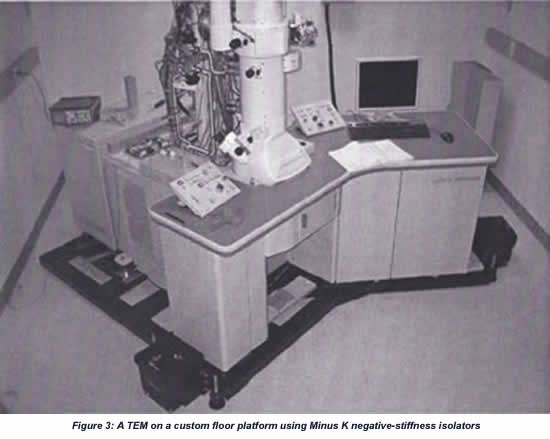
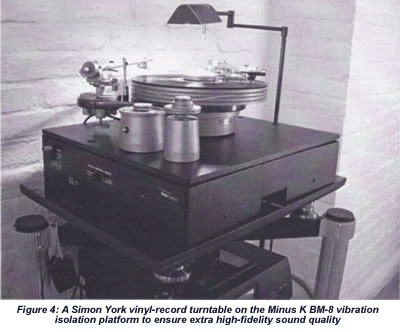
Minus K Technology Inc. was established in 1993 to develop, manufacture and market vibration-isolation products based on a "negative-stiffness-mechanism", shown in Figure 2, and patented by its founder (see the paper by D.L.Platus, which may be downloaded from www.minusk.com/documents/bibliography/Platus% 20SPIE%20July %201999.pdf). The mechanism reduces the effective force constant k (hence the name of the company), and allows the design of compact systems with 6 degrees of freedom and low-natural frequency. A custom-built floor platform is shown m Figure 3. The company's standard vibration isolation products include bench-top platforms such as the BM-8, which has dimensions of 457 X 508 X 117 mm and a payload up to 48kg (Figure 4). The platform needs no air or electricity supply, and is simple to use. It has a natural frequency of 1.5 Hz horizontally, and 0.5 Hz vertically, and a transmissibility of less than - 40 dB for frequencies of 4 Hz and above. The company also makes free-standing workstations such as the MK26 series. This has a tabletop 1,220 X 914mm, is Class 100 cleanroom compatible, and supports equipment weighing up to 295kg. Minus K passive isolation systems are available through Novascan, which develops instrumentation for molecular detection including scanning probe microscopes (SPM).
Accelerometers and activators
Halcyonics GmbH makes active vibration isolation systems that work by monitoring the absolute velocity of the mass to be isolated, and generating a compensating movement from an actuator. The Micro 40 and Micro 60 benchtop units, for example, protect compact scientific instruments from vibrations from about 0.6 Hz to infinity, providing 40 dB attenuation above 10 Hz. Halcyonics was founded in 1996 and started its own production line in 2001, after buying the intellectual property from a former Swiss partner. It owns a series of patents on active vibration isolation technology. The actuator replaces the viscous damper.
 The electromechanical sensors detect absolute motion in all 6 axes, and the actuators immediately counteract this motion. In contrast, viscous damping in a traditional passive system depends on the velocity of the mass relative to the floor.
The Micro 40 and 60 are designed for portability, with an automated transport-locking mode and automatic load adjustment for quick set-up. They come with a USB port and special application software that allows the user to test and display the vibrations at various places within the laboratory, and thus select the best place to locate sensitive equipment. Piezo-electric acceleration sensors detect the vibrations and electro-dynamic actuators provide vertical and horizontal corrective forces. These isolators take a maximum load of 100 kg and draw a typical 10 W from a 100-250 V ac supply. The company also makes active workstations with table-top dimensions up to 900 X 750mm, and supporting loads up to 160kg. Its latest product is the Nano 20, a very small active vibration isolation system with dimensions 204 X 204 X 69mm and a weight of 5.6kg. It is designed for SPM, with mass of up to 8kg. The user simply sets it in place and connects the cables. No adjustments or tuning are required before operating.
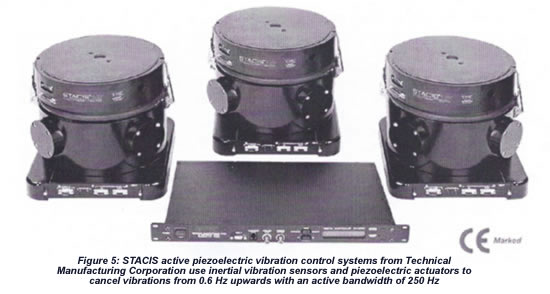
Technical Manufacturing Corporation (TMC) also makes active vibration isolation platforms, and traces active feedback vibration control technology back to helicopter seats in the 1950s. The recent upsurge of interest arises from the need for nanometre-resolution positioning of production and inspection equipment in the semiconductor industry. Modern active control is facilitated by advances in digital signal processing, which unlike analogue systems, require no manual adjustments. TMC holds patents on its STACIS® line of active isolators (Figure 5), in which an intermediate mass is hard mounted to the floor through a piezoelectric transducer. A geophone between the intermediate mass and the supported mass senses motion and feeds back its signal to the transducer in a wide-bandwidth servo loop. The company claims the vibration performance in the 0.6-20 Hz frequency range is among the best available. STACIS isolates precision microlithography, metrology, and inspection equipment in advanced semiconductor factories, and there are hundreds of installations world-wide. TMCs latest product is the Electro-Damp® series designed to increase throughput, resolution, and yield in semiconductor manufacturing applications. It comes in the form of individual modules, or integrated into a frame or sub-system.
Applications
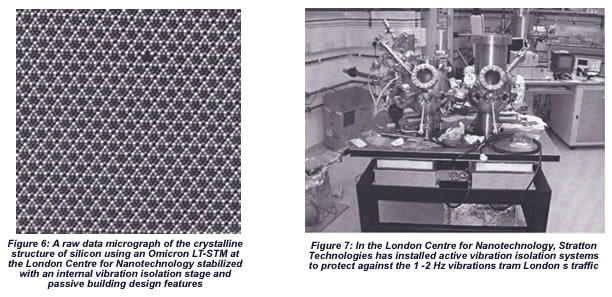
The London Centre for Nanotechnology carries out precision fabrication and characterization of nanostructured devices. Situated at the heart of London, the building has passive vibration features to help isolate the sensitive equipment from the effects of ground-level traffic and underground tube trains.
In addition, the microscopes are mounted on vibration isolation platforms to achieve the resolution shown in Figure 6. Stratton Technologies Ltd installed the system shown in Figure 7, which includes thermal isolators from the oil pipeline industry to protect the vibration isolators during bakeout procedures.
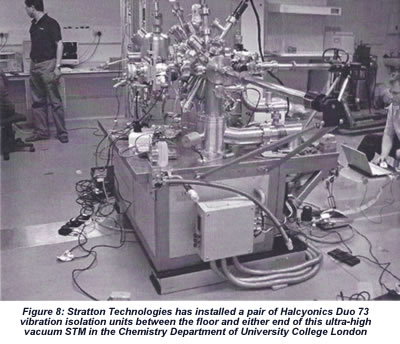
Stratton Technologies specializes in custom solutions and works with its customers, surveying the site where necessary to determine the exact nature of the vibration problems. It supplies active vibration isolation solutions from Halcyonics and passive solutions from Vistek Inc. The former isolate advanced microscopes such as the scanning tunneling microscope (STM) shown in Figure 8, scanning electron microscopes and SPMs. The Vistek passive systems arc used in optical microscopy applications.
 At the Center for Learning and Memory (CLM) at the University of Texas, a multidisciplinary team is studying the mechanisms governing the processes of learning and memory. They use a JEOL-1400 transmission electron microscope (TEM) to identify and study functional units smaller than 250 nm within nerve cells. Situated on the 5th floor, the instrument was subject to vibrations in the challenging frequency range 1.5 to 2.5 Hz. Minus K custom designed a 0.4 Hz negative-stiffness isolation system mat brought these vibrations below 1 um amplitude, and well into specification. The platform is shown in Figure 3.
Another unusual application for a Minus K system is shown in Figure 4. The Simon York turntable is one of the leading high-end turntables for playing vinyl records. It was made specifically for use in archiving, and is to be found in the National Sound Archives, in universities, and in the US Library of Congress in Washington. It is also used by hi-fi enthusiasts, as in this illustration.
Contacts
Stratton Technologies Ltd, Biggleswade, UK - www.strattontechnologies.co.uk
Novascan Technologies, Inc., Ames, IA, USA - www.novascan.com
Minus K Technology, Inc., Inglewood, CA, USA - www.minusk.com
Technical Manufacturing Corporation, Peabody, MA, USA - www.techmfg.com
Herzan LLC, Laguna Hills, CA, USA - www.herzan.com
Kinetic Systems Inc., Boston, MA, USA - www.kineticsystems.com
Intracel Ltd, Royston, UK - www.intracel.co.uk
Vistek Inc., Phoenix, AZ, USA - www.vistekinc.com
Halcyonics GmbH, Goettingen, Germany - www.halcyonics.de
Center for Learning and Memory, University of Texas, Austin, USA - www.clm.utexas.edu
London Centre for Nanotechnology, London, UK - www.london-nano.com