
Commercial Micro Manufacturing - November 2025
Satellite Micro-Vibration Test Platform Integrates Negative-Stiffness Vibration Isolation with Active Seismometers to Isolate Vibrations to 0.1 Hz.
by Jim McMahon
Developed by the National Physical Laboratory for the European Space Agency, the micro-vibration platform is used to measure internal vibrations, and to test satellite components under a range of controlled vibration conditions to ensure that they can operate correctly in a satellite environment without affecting other sensitive systems. The platform is so sensitive it can measure the force of a single dropped feather, and significantly reduce the effects of vibrations coming from waves of the nearby North Sea.
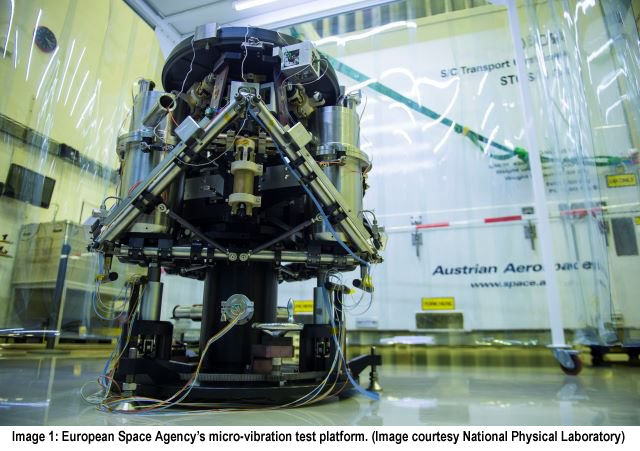
The European Space Agency (ESA) has added a micro-vibration test instrument, developed by the National Physical Laboratory (NPL), to its satellite testing facilities. NPL is the UK’s National Measurement Institute, developing and maintaining the national primary measurement standards. The instrument measures vibrations generated by satellite subsystems, to quantify their effects on images and measurements made from space. This facility is the result of five years of collaboration between NPL and ESA.
Vibrations onboard a satellite can be caused by common instruments and mechanisms, such as spinning reaction wheels, solar array drives and rotating cryocoolers. ESA needed to be able to measure and correct for these jitters and vibrations to improve the accuracy of its Earth observations. This required the simulation of satellite components under a range of controlled vibration conditions.
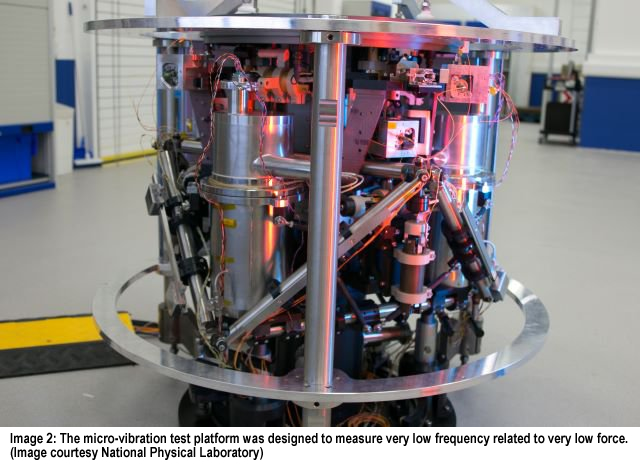
“The NPL won a tender to design a system for the European Space Agency which required a very high level of performance,” said Dan Veal, Senior Research Scientist with the National Physical Laboratory in the United Kingdom. “The system was required to measure very low frequency related to very low force. ESA needed a better way to check satellite components for these micro-vibrations, and to what effect they might disrupt a spacecraft.”
Measurement Platform Supported by a Vibration Isolation Platform
“NPL developed a platform which is able to characterize any force produced by a satellite component weighing up to 150 pounds,” added Veal.
The micro-vibration platform can measure vibrations to an unprecedented degree of accuracy. It is so sensitive it can measure the force of a single dropped feather. Sometimes housed in a vacuum chamber to simulate space conditions, when used in air the system is enclosed in a tent to limit perturbations caused by airflow.
The platform is built as a structure of two main levels: 1) a lower vibration isolation platform to cancel disturbances coming from the ground; and 2) an upper measurement platform.
Lower Vibration Isolation Platform
The lower vibration isolation platform uses a passive Negative-Stiffness vibration isolator, coupled with three highly sensitive active seismometers which control actuators, to sense ground vibrations coming into the system. The seismometers are designed to measure to 0.3 hertz. Coupled with the Negative-Stiffness isolators, the passive/active system enables vibration isolation down to 0.1 Hz.
This system significantly reduces the effects of the vibration coming from sources, such as footsteps and even waves from the nearby North Sea, ensuring a quiet environment for the measurement platform that is mated on top.
“We developed the lower vibration isolation platform around Minus K’s Negative-Stiffness isolators because they are capable of passively isolating vibrations down to 0.5 Hz,” explained Veal. “This was very important for our low-frequency application. But we also selected Negative-Stiffness because it is vacuum compatible.”
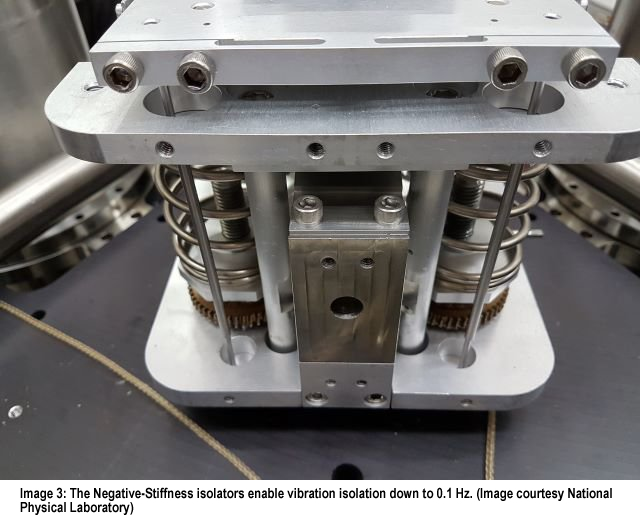
“Essentially, we stripped the Negative-Stiffness isolators down to their core systems, then augmented them with active seismometers connected with a custom interface,” explained Veal. “This enabled us to get down to 0.1 Hz isolation.”
Negative-Stiffness vibration isolation was developed by Minus K Technology, an OEM supplier to leading manufacturers of scanning probe microscopes, micro-hardness testers and other vibration-sensitive instruments and equipment, such as for testing zero-g simulation of spacecraft. The company’s isolators are used by more than 300 universities and government laboratories in 52 countries.
These vibration isolators are compact, and do not require electricity or compressed air which enables sensitive instruments to be located wherever a production facility or laboratory needs to be located. There are no motors, pumps or chambers, and no maintenance because there is nothing to wear out. They operate purely in a passive mechanical mode.
What is very advantageous about Negative-Stiffness isolators is that they achieve a high level of isolation in multiple directions. These isolators have the flexibility of custom tailoring resonant frequencies to 0.5 Hz* vertically and horizontally (with some versions at 1.5 Hz horizontally).
(*Note that for an isolation system with a 0.5 Hz natural frequency, isolation begins at 0.7 Hz and improves with increase in the vibration frequency. The natural frequency is more commonly used to describe the system performance.)
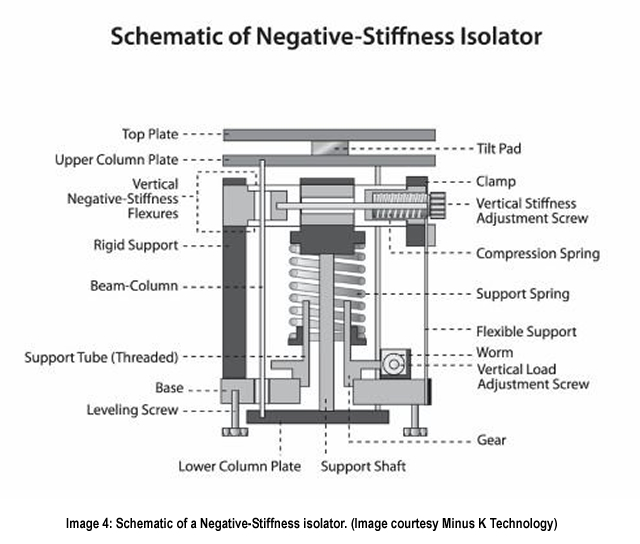
“Vertical-motion isolation is provided by a stiff spring that supports a weight load, combined with a Negative-Stiffness mechanism,” said Erik Runge, Vice President of Engineering at Minus K Technology. “The net vertical stiffness is made very low without affecting the static load-supporting capability of the spring. Beam-columns connected in series with the vertical-motion isolator provide horizontal-motion isolation. A beam-column behaves as a spring combined with a negative-stiffness mechanism. The result is a compact passive isolator capable of very low vertical and horizontal natural frequencies and high internal structural frequencies.”
Negative-Stiffness isolators deliver very high performance, as measured by a transmissibility curve. Vibration transmissibility is a measure of the vibrations that are transmitted through the isolator relative to the input vibrations.
Negative-Stiffness isolators, when adjusted to 0.5 Hz, achieve approximately 93 percent isolation efficiency at 2 Hz; 99 percent at 5 Hz; and 99.7 percent at 10 Hz.
Upper Measurement Platform
Resting on top of the lower vibration isolation platform is the upper measurement platform. This platform allows for two modes of operation:
- It can measure the forces and torques exerted by a specimen mounted on the test table to micronewton scale;
- It actively produces and directs a predefined micro-vibration disturbance in multiple axes simultaneously onto a specimen, to test its susceptibility to such disturbances.
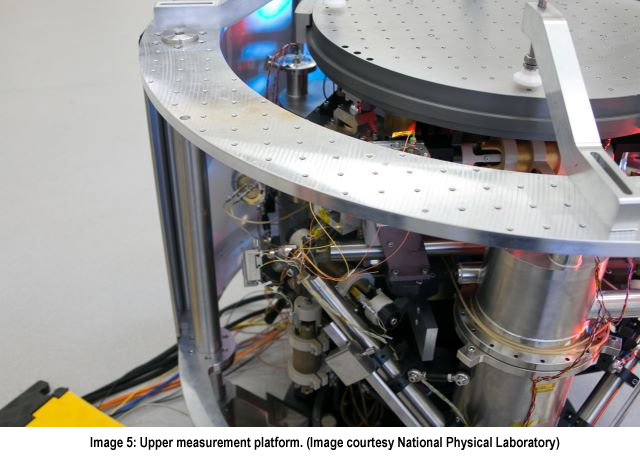
To effect the level of precision needed for the upper platform, NPL custom-designed and manufactured many of the system’s components to extremely strict requirements. This included such devices as actuators, which were custom designed for magnet size, windings, coils and linearity.
Validating Micro-Vibration Measurement of Satellite Components
The micro-vibration test instrument gives the ESA a high confidence that a satellite’s mechanisms in space will generate verified forces and torques as displayed and confirmed on the micro-vibration test instrument on Earth. ESA, and its contracted manufacturers, rely on exact specifications as developed, verified and standardized by NPL research acquired from the micro-vibration test instrument. Critical to the success of this project has been Negative-Stiffness vibration isolation.
About National Physical Laboratory (NPL)
NPL is the UK's National Measurement Institute, developing and maintaining the national primary measurement standards. It is a public corporation owned by the UK Government's Department of Business, Energy and Industrial Strategy (BEIS).
NPL is part of the National Measurement System which provides the UK with a national measurement infrastructure and delivers the UK Measurement Strategy on behalf of BEIS.
NPL undertakes excellent science and engineering to deliver extraordinary impact for the UK, and provide the measurement capability that underpins the UK's prosperity and quality of life. From accelerating new antibiotics and more effective cancer treatments to developing unhackable quantum communications and superfast 5G, its expertise is crucial in researching, developing and testing new products and processes.
For more information, contact Dan Veal, Senior Research Scientist, NPL Instruments, National Physical Laboratory; Hampton Road, Teddington, TW11 OLW, UK; Phone +44 (0) 208 943 6125; email dan.veal@npl.co.uk; www.npl.co.uk/length.
About Minus K Technology, Inc.
Minus KŪ Technology, Inc. was founded in 1993 to develop, manufacture and market state-of-the-art vibration isolation products based on the company’s patented Negative-Stiffness technology. Minus K products are used in a broad spectrum of applications including microscopy, nanotechnology, biological sciences, semiconductors, materials research, zero-g simulation of spacecraft, and high-end audio. The company is an OEM supplier to leading manufacturers of scanning probe microscopes, micro-hardness testers and other vibration-sensitive instruments and equipment. Minus K customers include private companies and more than 300 leading universities and government laboratories in 52 countries.
|