
Lab Product News - February 2007
Technical Applications
New solutions needed for vibration control in nanotechnology
By Jim McMahon
It wasn't long ago that making the decision where to locate a scanning probe microscope was straightforward. Most labs put it in the basement where ambient vibration was minimized. But today, with nanotechnology applications growing exponentially, scientists and engineers often need to put these sensitive instruments in other locations, where vibration noise is significantly higher. Scanning probe microscopes, interferometers and stylus profilers are sometimes being sited in locations that pose a serious challenge to vibration isolation.
 "Vibration isolators are one of those necessities that people are not really focused on when they go to purchase an instrument like an AFM (atomic force microscope)," says George McMurtry, CEO of NanoAndMore, a distributor of AFM probes and nanotechnology peripherals.
"But it is different with the bigger scanning electron microscopes and transmission electron microscopes, because you are dealing with a very expensive piece of gear that technically needs all sorts of isolation in order to work properly. They are more apt to talk about it right up front.
"But with smaller instruments such as white light interferometers, laser interferometers, stylus profilers, and atomic force microscopes, the situation is different, he says, and problems with site preparation are more frequent. If, for example, the lab is on the 4th floor of a building, without isolation, the users will end up getting very poor images.
"There are so many more people using AFMs in so many different environments that isolators are needed more often," says Mark Flowers, president of Nanoscience Instruments, a distributor of atomic force microscopy products. "In the early days you could put your AFM in the basement of your building, now people want to use their AFMs on the 3rd floor. But in the basement you are going to have a much better environment, and you could get by with an unsophisticated isolator."
The vibrations are subtle. Within the building itself many things cause vibration, such as the heating and ventilation system, fans, pumps that are not properly isolated, and elevators. Outside the building, vibrations from adjacent traffic, wind, construction, and other elements can also affect equipment.
The lower-frequency vibrations resulting from these forces cause havoc for instruments trying to measure a very few angstroms or nanometers of displacement.
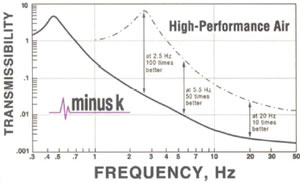
Air tables with resonant frequencies at 2 to 2-1/2 Hz can typically only handle vibrations down to about 8 to 10 Hz, not quite low enough for optimum performance with modern nano-equipment. Therefore, for purposes of clarity in scanning probe microscopes and interferometers, air tables are an inefficient isolation solution.
Another solution is active isolation, also known as electronic force cancellation. Active isolation senses motion electronically, and adds equal amounts of motion to compensate, effectively cancelling out the motion. Isolation begins as low as 0.7 Hz, which is sufficient for isolating the lower frequencies that are so damaging to image clarity with SPMs and interferometers.
However, due to their dependence on electricity, these isolators are vulnerable to electronic dysfunction and power modulations, which can interrupt scanning.
Another solution is a negative-stiffness vibration isolation system, which has the added benefit of lower operating costs than active systems.
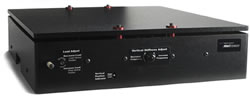 "This is a passive approach for achieving low vibration environments and isolation against sub-Hertz vibrations," says Dr David Platus, inventor of the negative-stiffness technology, and president and founder of Minus K Technology. "These isolation systems enable vibration-sensitive instruments, such as scanning probe microscopes, micro-hardness testers and scanning electron microscopes to operate in severe vibration environments, such as upper floors of buildings and clean rooms. The images and data produced are many times better than those achievable with pneumatic isolators."
Negative-stiffness isolators employ a mechanical concept in low-frequency vibration isolation. Vertical-motion isolation is provided by a stiff spring that supports a weight load, combined with a negative-stiffness mechanism (NSM). The net vertical stiffness is made very low without affecting the static load-supporting capability of the spring. Beam-columns connected in series with the vertical-motion isolator provide horizontal-motion isolation. The horizontal stiffness of the beam-columns is reduced by a beam-column effect. (A beam-column behaves as a spring combined with an NSM.)
The result is a compact passive isolator capable of very low vertical and horizontal natural frequencies and very high internal structural frequencies. The isolators (adjusted to 1/2 Hz) achieve 93% isolation efficiency at 2 Hz; 99% at 5 Hz; and 99.7% at 10 Hz.
"Improved vibration isolation directly correlates to improved instrument performance," says Patrick O'Hara, president and CEO of Ambios Technology, a manufacturer of SPMs, stylus profilers and optical interferometers used in nanotechnology. "When you are trying to measure atomic scale features, mechanically stable support structures are critically important. Up until the advent of probe microscopes, and some of the other very high-resolution imaging and data acquisition techniques, air isolators were adequate for most of applications. But not any longer."
He adds that although active isolation systems have fundamentally no resonance, their transmissibility does not roll off as fast as
negative-stiffness isolators. As a result, at building and seismic frequencies, the transmissibility of active isolators can be 10X greater than negative-stiffness isolators. This causes substantial adverse measurement and imaging artifacts in the data.
Further, he says that air isolators have the added disadvantage that their 2 to 2-1/2 Hz resonance effects a significant loss in isolation capability below about 5 Hz, and he feels that negative-stiffness isolators are the most efficient choice for probe microscopes.