
Laboratory Equipment - July 2009
Vibration Isolation Pushes Brain Research Ahead
Negative-stiffness vibration isolators help researchers to measure micron-level patterns of neuronal activity and thus shed new light into cardiac fibrillation and epilepsy.
By Jim McMahon
Isolating a laboratory's sensitive microscopy equipment against low-frequency vibration has become increasingly vital to maintaining imaging quality and data integrity for neurobiology researches. Researchers are discovering that conventional air tables and the more recent active (electronic) vibration isolation systems are not able to cancel out the lower frequency perturbations derived from air conditioning systems, outside vehicular movements, and ambulatory personnel.
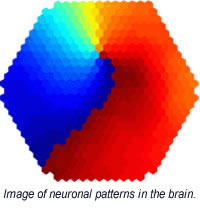 Propagating Waves in Neocortical Slices
At the Georgetown University Medical Center in the Department of Physiology and Biophysics, Professor Jian-Young Wu and his colleagues visualize wave-like patterns in the brain cortex using a new method called voltage-sensitive dye imaging. The special dye used binds to the membrane of neurons and changes color when electrical potential changes on the membrane of active neurons. The neuronal sample is derived from slices of rat neocortex.
The neocortex is the outer layer of the cerebral hemispheres in the brain of mammals. Made up of six layers, it is involved in higher functions such as sensory perception, generation of motor commands and, in humans, language.
"With optical methods and voltage-sensitive dyes, we can visualize the activation in a large area of the neocortex when the brain is processing sensory information," explains Dr. Jian-Young Wu.
"Voltage-sensitive dye is a compound that stains neuronal membrane and changes its color when the neuron is excited," Wu continues. "This allows us to visualize population neuronal activity dynamically in the cortex. We study how individual neurons in the neocortex interact to generate population neuronal activities that underlie sensory and motor processing functions. Population activities are composed of the coordinated activity of up to billions of neurons. Currently, we study how oscillations and propagating waves can be generated by small ensembles of neocortical neurons."
Spiraling Waves Shed Light
Wu's imaging team has uncovered spiraling wave patterns resembling little hurricanes in the brain. "If you were to dissect a hurricane into individual air molecules, you would not find any special process that generates a hurricane. Similarly, in the nervous system, spiral waves are an emergent process of the neuronal population, and there might be no special cellular process attributed to spirals," says Wu.
But like a hurricane, spiral waves can be a powerful force for organizing the activity of a neuronal population. Spirals generated in a small area can send out a powerful storm that invades large, normal brain areas and starts a seizure attack. This hypothesis would mean that epilepsy could be viewed not just as miss-wiring in the brain but as an abnormal wave pattern that invades normal tissue.
Similarly, during cardiac fibrillation, spiral waves form in the heart, emitting rotating and scroll waves in two and three dimensions. These rotating waves can kill a patient instantly as the pumping function of the heart is disrupted by the 5- to 10-Hz rotations that drive chaotic and abnormally rapid cardiac contractions.
Wu believes that propagating waves are a basic pattern of cortical neuronal activity, and these wave patterns may play an important role in initiating and organizing brain activity involving billions of neurons. Studying the spatiotemporal patterns of neuronal population activity may provide insight into normal brain functions and pathological disorders. This research has the potential to help scientists understand abnormal waves that are generated in the brains of patients with epilepsy.
Schematic of Negative-Stiffness Isolator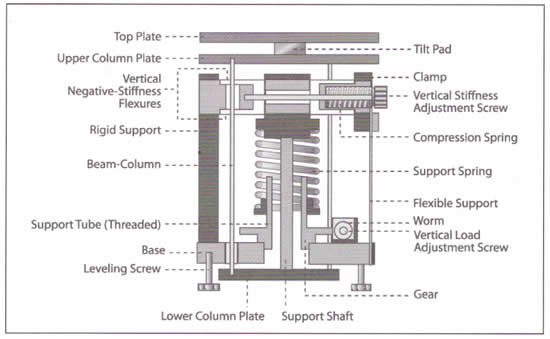
Vibration Isolation
Because voltage-sensitive dye signals are small, usually a change of 0.1% to 1.0% of the illumination intensity, Wu's team has used a high-dynamic-range camera, photodiode array to detect the signals of the cortical activity. The photodiode array can resolve extremely small changes in light, usually one part of ten thousands.
Detecting such small signals requires an extreme isolation of vibration. The lab had to contend with low-frequency vibrations from air conditioning equipment, people walking and wind blowing against the building. Vibrations as low as 1 Hz were inhibiting the integrity of the images and data.
"At first, we used high-quality air tables, but they were not adequate for isolating low-frequency vibrations," explains Wu. "We tried putting a second air table on top of the first one, but that still did not give us the isolation we needed. Then we tried an active, electronic system, but we were still spending much time fighting with floor vibrations."
The Georgetown lab eventually tested and settled upon negative-stiffness mechanism vibration isolation systems from Minus K Technology, which enabled the lab to get vibration isolation down to a level of 1 Hz. This effectively cancelled out any vibration noise difficulties that were inhibiting image and data readings.
Negative-stiffness mechanism (NSM) isolators have the flexibility of custom tailoring resonant frequencies vertically and horizontally. They employ a completely mechanical concept in low-frequency vibration isolation. Vertical-motion isolation is provided by a stiff spring that supports a weight load, combined with an NSM. The net vertical stiffness is made very low without affecting the static load-supporting capability of the spring.
Beam-columns connected in series with the vertical-motion isolator provide horizontal-motion isolation. The horizontal stiffness of the beam-columns is reduced by the "beam-column" effect. A beam-column behaves as a spring combined with an NSM. The result is a compact passive isolator capable of low vertical and horizontal natural frequencies and high internal structural frequencies.
Transmissibility with negative-stiffness is substantially improved over air systems, which can make vibration isolation problems worse since they have a resonant frequency that can match that of floor vibrations. Transmissibility is a measure of the vibrations that transmit through the isolator relative to the input vibrations. The NSM isolators, when adjusted to 0.5 Hz, achieve 93% isolation efficiency at 2 Hz, 99% at 5 Hz, and 99.7% at 10 Hz.
NSM transmissibility is also improved over active systems. Because they run on electricity, active systems can be negatively influenced by problems of electronic dysfunction and power modulations, which can interrupt scanning. They also have a limited dynamic range that is easy to exceed, causing the isolator to go into positive feedback and generate noise underneath the equipment. Although active isolation systems have fundamentally no resonance, their transmissibility does not roll off as fast as negative-stiffness isolators.
Continuing Research
Within the past 10 years, Wu's team has documented a variety of waveforms in brain slices during artificially induced oscillations. Using neocortical slices and mathematic models, they are studying the initiation of the waves and the factors that control their propagating direction and velocity.
The lab is also involved in developing new optical imaging techniques "to visualize waves in the cortex in vivo during sensory processes and in awake animals while behavioral and cognitive tasks are performed," says Wu.
For more information, contact:
Dr. Jian-Young Wu, Ph.D., wuj@georgetown.edu, www.georgetown.edu
Steve Varma, Minus K Technology, Inc., 310-348-9656, sales@minusk.com, www.minusk.com