
Electronic Products - October 2007
New form of isolation may aid nanotechnology development
 Richard Coinerford
The minuteness of nano-devices makes it necessary to isolate them and their surrounding test equipment from vibration. Unfortunately, the cost of commonly used active vibration isolators can overtax a start-up R&D labs' budget. Hence, one may find atomic force microscopes suspended by bungee cords in some labs.
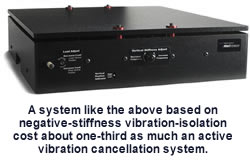
Because their cost can be about one-third that of active systems, negative-stiffness vibration isolation systems invented by David L. Platus of Minus K Technology promise to solve this problem. Whereas active isolation uses electronics to sense the motion and put out equal amounts of energy to cancel vibration, negative-stiffness isolators
Vertical-motion isolation is provided by a stiff spring that supports a weight load, combined with a negative-stiffness mechanism. The net vertical stiffness is very low without affecting the spring's static load-supporting capability. Beam-columns connected in series with the vertical-motion isolator provide horizontal isolation.
The result is a compact passive isolator capable of very low vertical and horizontal natural frequencies. The isolators (adjusted to 1/2 Hz) achieve 93% isolation efficiency at 2 Hz; 99% at 5 Hz; and 99.7% at 10 Hz. For more information, contact Steve Varma at Minus K Technology 310-348-9656; or visit www.minusk.com employ a completely mechanical approach.