
Biophotonics International - March 2008
More than just floating on air
By Gary Boas
Researchers with Yale University School of Medicine's department of cellular and molecular physiology in New Haven, Conn., had a problem. For years, they had been developing methods for monitoring brain activity - specifically, for using voltage-sensitive and calcium-sensitive dyes to look at the activity of neurons. Taking advantage of high-power microscopes and high-speed cameras, they had been able to track neuron activity with millisecond temporal resolution and micron spatial resolution, enabling them to examine the processing of olfactory information in the turtle and the mouse, for example.
This wasn't the problem, of course. The problem was that, when measurements were performed at such high resolution, the smallest movement in the laboratory could seriously affect the results.
"Because only a small fraction of neurons are active at any one time, the activity signals are very small - maybe one-tenth or one-hundredth of a percent," said Lawrence B. Cohen, a principal investigator. "When you get down to one-tenth or one-hundredth of a percent, vibrations can overshadow the signal."
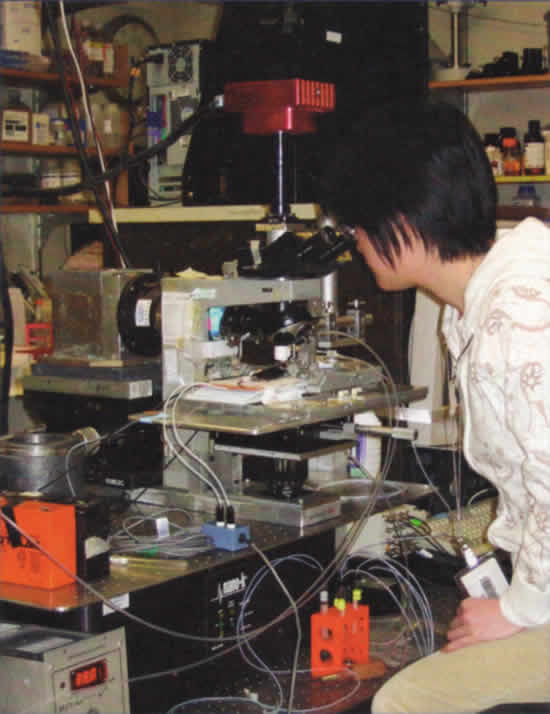
A vibration isolation system that works in both the X-Y and the Z-planes (the Nano-K device immediately under the microscope) is allowing researchers to study neuron activity with micron resolution. The system acts as the negative of a spring and thus drastically reduces ambient vibrations with especially low natural frequencies.
Cohen and his colleagues had tried for years to minimize or even to eliminate vibrations using conventional air tables, with only some success. Air tables, which have been found in laboratories for the past 40 or 50 years, incorporate cans of air into the legs - so the microscope or other instrument essentially is sitting on a cushion of air. This arrangement helps to minimize movement in the Z-plane; if you push a table down, it absorbs the pressure. Air tables generally are not so successful at reducing side-to-side motion - X-Y movement - however, and it is these vibrations that most affect vertical microscope measurements.
For this reason, the researchers have adopted the negative-stiffness vibration isolation system made by Minus K Technology Inc. of Inglewood, Calif. The system provides vibration isolation in both the X-Y and the Z-planes using beam columns and springs coupled with a negative-stiffness mechanism, which acts, mathematically, as the negative of a spring, explained David L. Platus, president of the company.
"[The] force to cause unit displacement is by definition the stiffness of the spring," he said. "What happens in this configuration is, as you push on the system, the negative-stiffness mechanism is helping you push. It amplifies the force, so you don't have to push as hard. Thus, it reduces the stiffness of the whole system and lowers the natural frequency." The mechanism works with springs in the vertical direction and with beam columns in the horizontal direction.
Platus added that, whereas conventional air tables typically have a natural frequency of approximately 2 or 3 Hz, the negative-stiffness system has one of 0.5 Hz or less. The lower natural frequency enables isolation of lower-frequency vibrations such as those caused by vehicles passing, by air conditioning systems humming or even by wind blowing.
The Yale group recently used the vibration isolation system to screen fluorescent protein voltage sensors for use in transgenic mice, reporting the study in a Journal of Neuroscience Methods paper last year. They imaged HEK 293 cells and dissociated hippocampal neurons using a Nikon microscope outfitted with a 60X, 1.0-NA water-immersion lens. A 150-W xenon arc lamp made by OptiQuip of Highland Mills, N.Y., served as the source of excitation. A CCD camera made by RedShirtlmaging of Decatur, Ga., detected fluorescence emissions. The imaging apparatus was mounted on a Minus K vibration isolation platform, thus allowing essentially vibration-free imaging of the neurons.
The researchers found that three first-generation voltage sensors showed predominantly intracellular staining in the cells and for this reason were poor sensors of membrane potential. More recent experiments using a Ciona-GFP construct showed better binding to the external membrane as well as larger optical signals. In the future, these all-protein voltage sensors could be directed to specific cell types in the brain and thus could prove advantageous over conventional organic dyes.
The negative-stiffness system is not the only alternative to air tables. Electronic force cancellation systems detect vibrations using motion sensors, velocity sensors or accelerometers and then respond with equal and opposite electronic forces provided by piezoelectric transducers, for example. Platus noted, however, that these are more expensive and in some trials were outperformed by the negative-stiffness system. They are subject to the anomalies of the electric power source, and they cannot always compensate for a door slamming or for a stomp on the floor, for instance.
He added, though, that the electronic systems can do things the negative-stiffness system cannot. "If there's a source of vibration right on the payload, that's not coming from the floor or the ground; we can't do anything about that," he said. "Our system takes care of ambient vibrations, and in most applications you want to isolate a microscope or other sensitive instrument from the vibrations that are all around."
Contact: Lawrence B. Cohen, Yale University; e-mail: lawrence.cohen@yale.edu; David L. Platus, Minus K Technology; e-mail: david@minusk.com.